





What's Happening?
AMD, led by CEO Lisa Su, is set to establish its first Asian Artificial Intelligence (AI) research center in South Korea by the end of the year. This initiative, announced in a joint op-ed by Lisa Su and Bae Kyung-hoon, South Korea's Deputy Prime Minister
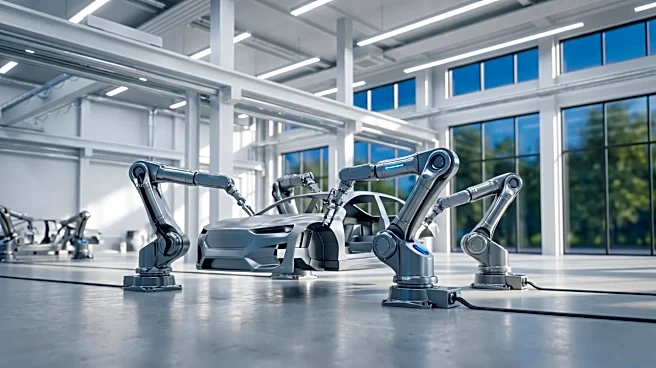
and Minister of Science and ICT, aims to create an open-source AI computing infrastructure. The 'AI Center of Excellence' will expand collaboration with universities and research institutions, focusing on joint AI research in scientific fields such as drug discovery, climate, and energy challenges, as well as physical AI areas like manufacturing and robotics. The center will also work on demonstrating heterogeneous computing, combining South Korean-made Neural Processing Units (NPUs) with AMD's Graphics Processing Units (GPUs) and Central Processing Units (CPUs), co-developing next-generation AI infrastructure and software, and cultivating specialized talent. This move follows a memorandum of understanding signed in July on 'building an open AI ecosystem,' emphasizing mutual compatibility between diverse hardware and software.
Why It's Important?
This establishment signifies a strategic shift for South Korea, moving beyond being solely a consumer of global AI semiconductors to becoming a partner in co-designing AI computing technologies and systems with international companies. For AMD, this represents a significant investment in a region known for its world-class memory semiconductor competitiveness and a robust industrial base for physical AI applications, including manufacturing, robotics, mobility, shipbuilding, and defense. The collaboration aims to foster an open AI ecosystem, which could accelerate innovation by allowing different technologies to work together more effectively. This approach contrasts with closed ecosystems centered on specific companies, potentially leading to more diverse and accessible AI solutions. The initiative also highlights the growing importance of international partnerships in advancing AI research and development, particularly in areas with strong industrial and academic foundations.
What's Next?
The AMD AI Center of Excellence is expected to be established in South Korea by the end of the year. Following its establishment, the center will commence joint AI research with universities and research institutions across various scientific and physical AI fields. This will include efforts to demonstrate heterogeneous computing, co-develop next-generation AI infrastructure and software, and focus on talent cultivation. AMD's existing collaborations with South Korean companies, such as Samsung Electronics for HBM4 memory, Naver Cloud for CPU, GPU, and software optimization, and Upstage for large language model integration, are likely to be further strengthened and expanded through this new center. The success of this open AI ecosystem model could influence future international collaborations in the AI sector, potentially encouraging more companies to adopt similar open-source approaches.
Beyond the Headlines
The decision to establish an AI Center of Excellence in South Korea underscores a broader trend towards decentralizing AI development and fostering international collaboration to address complex global challenges. By focusing on an open-source ecosystem, AMD and the South Korean government are promoting a model that could democratize access to advanced AI technologies and prevent monopolization by a few dominant players. This approach has ethical implications, as it could lead to more transparent and accountable AI systems, reducing biases and promoting equitable access to AI's benefits. Furthermore, the emphasis on physical AI areas like manufacturing and robotics suggests a long-term vision for integrating AI into tangible industries, potentially transforming global supply chains and production methods. The cultivation of specialized talent within South Korea also points to a strategic investment in human capital, ensuring a sustainable pipeline of AI expertise for future innovations.