






What's Happening?
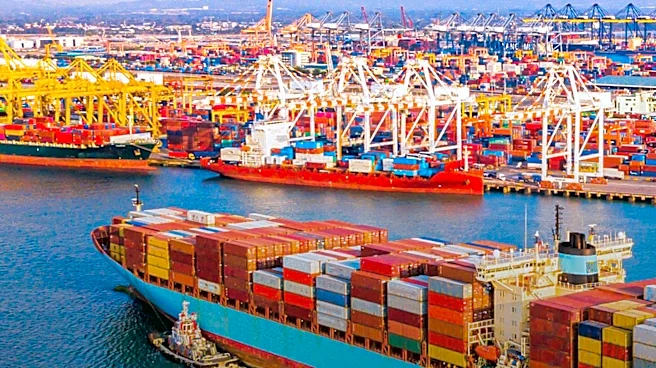
Flexport, a freight forwarding and supply chain platform, is actively tracking the container ship VALENCE (IMO 9628180, MMSI 229548000). The VALENCE, built in 2013, is currently sailing under the Malta flag. Flexport's Atlas platform provides real-time
visibility into the vessel's current position, estimated time of arrival (ETA), recent port calls, and detailed specifications. These specifications include a Length Overall (LOA) of 299 meters, a Deadweight Tonnage (DWT) of 110,692 tons, a Gross Tonnage (GT) of 95,390, and a capacity of 8,827 Twenty-foot Equivalent Units (TEU). As of a report on November 21, 2026, the VALENCE is operating on several routes, specifically ZIMU:Z7S 22E, MSCU:AMERICA GU644E, and MSCU:ENU NN642A. This tracking service is part of Flexport's broader offering to unify shipments, orders, and inventory for its clients.
Why It's Important?
The real-time tracking and detailed information provided by Flexport for vessels like the VALENCE are crucial for the efficiency and predictability of global supply chains. In an interconnected world, disruptions in shipping can have cascading effects on industries, consumer markets, and economic stability. By offering precise data on vessel movements, Flexport enables businesses to better manage their logistics, anticipate delivery times, and mitigate potential delays. This enhanced visibility helps companies optimize inventory levels, reduce warehousing costs, and improve overall operational planning. For U.S. businesses relying on international trade, this level of transparency can translate into more resilient supply chains, fewer stockouts, and ultimately, a more stable flow of goods to consumers, impacting various sectors from retail to manufacturing.
What's Next?
As Flexport continues to enhance its AI-powered platform, the integration of more sophisticated predictive analytics for vessel movements and potential disruptions is a foreseeable next step. This could involve leveraging historical data and real-time weather patterns to offer even more accurate ETAs and alternative routing suggestions. The ongoing development of such platforms will likely lead to increased adoption by businesses seeking to gain a competitive edge in supply chain management. Furthermore, the expansion of Flexport's network of offices and warehouses, currently spanning over 40 countries, suggests a continued effort to provide comprehensive logistics solutions globally. This could include further integration with various carriers and port authorities to streamline data exchange and improve end-to-end supply chain visibility for U.S. importers and exporters.
Beyond the Headlines
The detailed tracking of individual vessels like the VALENCE by platforms such as Flexport highlights a broader trend towards digitalization and data-driven decision-making in the traditionally complex and often opaque shipping industry. This shift has significant implications for global trade, fostering greater transparency and accountability across the supply chain. Beyond operational efficiencies, this enhanced visibility can also contribute to better environmental monitoring of shipping routes and potentially aid in compliance with international maritime regulations. The ability to precisely track cargo movements also has implications for security and risk management, allowing for quicker responses to unforeseen events. Ultimately, the evolution of these platforms is transforming how goods move globally, impacting everything from international trade policies to the carbon footprint of logistics.