





What's Happening?
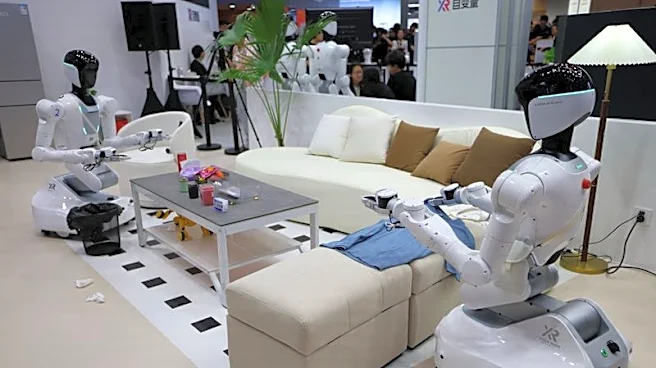
LiveX AI, a Palo Alto, California-based startup, has launched 'AI City,' a new platform featuring life-size, human-like AI hosts integrated into interactive kiosks. These AI hosts are designed to provide customer service and information in various physical
locations, including retail stores, airports, and hotels. The company has already deployed 100 units in sites such as PUMA stores, San Jose Mineta International Airport, SAP Center, the San Jose Sharks stadium, El Camino Hospital, and Marriott and Hilton hotels. Unlike traditional interactive kiosks that rely on fixed menus, AI City utilizes conversational AI, allowing users to ask open-ended questions and receive dynamic responses. The technology aims to replicate human interaction, freeing up human staff for more complex tasks. LiveX AI’s system runs on Nvidia RTX Pro 6000 Blackwell Server Edition GPUs and uses Nvidia Cosmos and the Nvidia Nemotron model for its visual AI agents.
Why It's Important?
The introduction of AI City by LiveX AI signifies a notable advancement in customer experience technology within the U.S. service industry. By deploying human-like AI hosts, businesses can potentially enhance efficiency and customer engagement, particularly in sectors like hospitality, retail, and healthcare. This technology could lead to reduced operational costs by automating routine customer inquiries and providing instant, multilingual assistance. For consumers, it offers a self-service option that is more intuitive and comprehensive than previous kiosk models. The adoption of such AI-powered solutions could set new standards for customer interaction, influencing how businesses design their physical spaces and allocate human resources. However, the success of these systems will depend on factors like accuracy, security, and the ability to seamlessly integrate with existing operational workflows, as highlighted by industry analysts.
What's Next?
LiveX AI plans to continue expanding the deployment of its AI City hosts across various industries, with a focus on enhancing customer service and operational efficiency. The company's technology, which leverages advanced Nvidia hardware and AI models, suggests a trajectory towards more sophisticated and integrated AI solutions in physical environments. Future developments may include further integration with backend systems like CRM and booking platforms, allowing the AI hosts to perform more complex tasks beyond answering questions. Industry analysts, such as IDC, emphasize the importance of governance, accuracy, security, and human oversight for the long-term success of agentic AI-enabled customer systems. The evolution of AI City will likely involve addressing these concerns to ensure reliable and trustworthy interactions, potentially leading to broader adoption and a transformation of customer service paradigms.
Beyond the Headlines
The emergence of life-size, human-like AI hosts like those in LiveX AI's 'AI City' raises profound questions about the future of human-computer interaction and the nature of customer service. While these kiosks offer efficiency and accessibility, they also touch upon ethical considerations regarding the replacement of human jobs and the potential for a less personal, albeit more efficient, service experience. The technology's ability to understand and respond in multiple languages without a learning curve could democratize access to information and services for diverse populations. However, the reliance on AI for critical interactions also necessitates robust safeguards against misinformation and technical failures. The long-term societal impact could include a shift in consumer expectations for instant and personalized service, pushing businesses to continually innovate their customer engagement strategies and potentially redefining the value of human interaction in commercial settings.