





What's Happening?
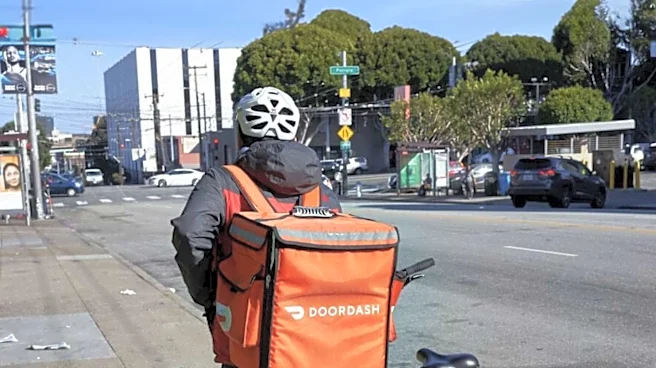
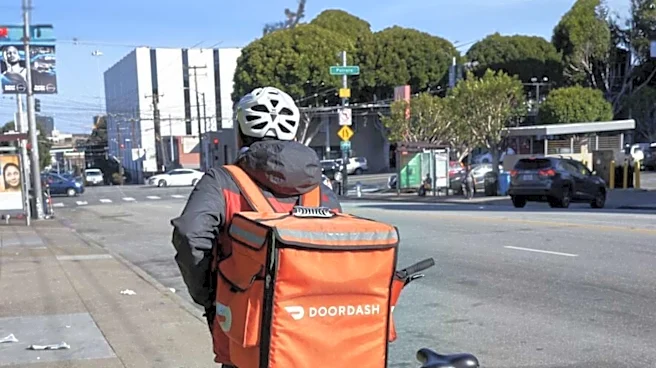
During DoorDash's Q3 earnings call, CEO Tony Xu disclosed that third-party AI-agent-placed orders constituted only a few hundred out of nearly 1 billion total orders for the quarter. This indicates a very small adoption rate for AI-driven ordering systems
within the food delivery giant's platform. In comparison, Uber Eats CFO Balaji Krishnamurthy reported approximately 500 agentic orders out of 320 million total food and ride orders during Halloween week, with only four of those being for actual rides. These figures suggest that while AI agents are being integrated into food delivery services, their current usage by consumers remains extremely low. The data highlights the nascent stage of AI agent adoption in the broader food and ride-sharing delivery market, despite significant advancements in artificial intelligence technology.
Why It's Important?
The minimal number of AI-agent-placed orders reported by DoorDash and Uber Eats is significant for the food delivery industry and the broader technology sector. It suggests that despite the hype surrounding AI, consumer adoption of fully automated ordering systems is still in its infancy. This could indicate several factors: a lack of consumer awareness, trust issues with AI agents handling personal preferences and payments, or simply that the current AI solutions do not yet offer a compelling advantage over traditional app-based ordering. For companies investing heavily in AI, these numbers might prompt a re-evaluation of their AI strategy, focusing more on user experience, reliability, and demonstrating clear benefits to consumers. It also highlights a potential gap between technological capability and practical market integration, suggesting that the 'future of food delivery' driven by AI agents is still some way off.
What's Next?
The low adoption rates for AI-agent-placed orders may lead DoorDash and Uber Eats to reassess their strategies for integrating and promoting AI within their services. Future developments could include enhanced marketing efforts to educate consumers on the benefits of AI agents, improvements in the AI's ability to understand and fulfill complex orders, or increased focus on specific use cases where AI agents can provide a distinct advantage. Companies might also explore partnerships with AI developers to refine the technology and make it more user-friendly and reliable. Additionally, the industry may see a shift towards more subtle AI integrations that assist users rather than fully automating the ordering process, such as personalized recommendations or predictive ordering, which could gradually build consumer trust and familiarity with AI-driven features.
Beyond the Headlines
The slow uptake of AI-agent-placed orders points to deeper implications regarding human-technology interaction and consumer behavior. It raises questions about the perceived value of full automation versus human control in everyday tasks like ordering food. Consumers might prefer the direct control and flexibility offered by traditional app interfaces, or they may harbor reservations about delegating such decisions to an AI, especially concerning personalized preferences or potential errors. This trend could also reflect a broader societal hesitancy towards fully autonomous systems, suggesting that while AI can perform tasks, the human element of choice and oversight remains crucial for widespread adoption. The ethical considerations of AI agents, such as data privacy and algorithmic bias, could also subtly influence consumer trust, even if not explicitly stated as reasons for low usage.