
What's Happening?
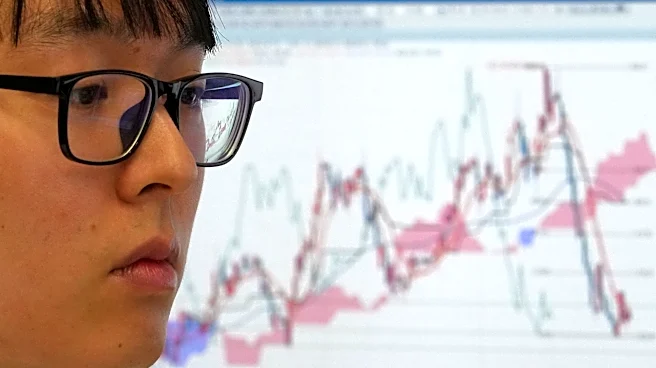
Bitcoin (BTC) saw a significant price surge, touching $64,446, before reversing to approximately $61,200. This volatility occurred on Monday, coinciding with the reinstatement of Nvidia CEO Jensen Huang.
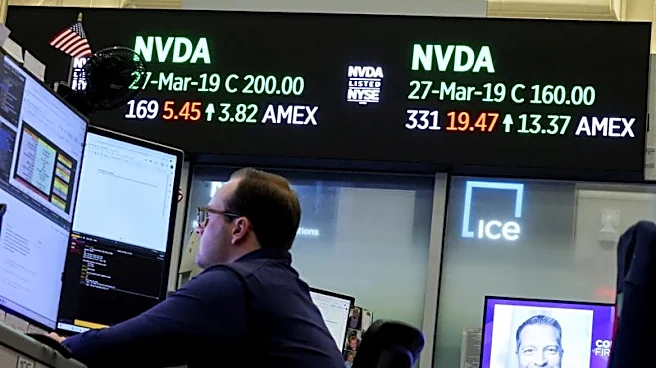
President Trump informed CNBC that he influenced the decision to reinstate Huang. While Bitcoin's 24-hour gain was modest at 0.7%, Nvidia's stock soared by 31%. The broader U.S. stock market also experienced substantial gains, with the Dow Jones Industrial Average closing up 3.01%, the S&P 500 gaining 4.73%, and the Nasdaq Composite increasing by 6.51%. AI-related stocks, such as Micron Technology and CoreWeave, also saw significant rises. The rapid spike and subsequent drop in Bitcoin's price suggest a potential short squeeze, where forced buying by exchanges temporarily inflates the price before fading demand leads to a reversal.
Why It's Important?
The divergent performance between Bitcoin and the stock market, despite initial parallel movements, highlights the distinct drivers influencing each. While traditional equities benefited from company-specific news and broader market sentiment, Bitcoin's surge appeared to be primarily linked to general risk appetite and technical trading patterns like short squeezes. This indicates that Bitcoin's price movements can be more susceptible to speculative trading and less tethered to fundamental corporate developments compared to established stocks. The event also underscores the influence of high-profile figures like President Trump on market sentiment, even if indirectly, as his reported involvement in Huang's reinstatement coincided with a broader market rally. For investors, the episode serves as a reminder of Bitcoin's inherent volatility and the need for caution when interpreting rapid price changes.
What's Next?
The immediate future for Bitcoin will likely be influenced by its own leverage and fund flows, particularly the performance of spot Bitcoin exchange-traded funds (ETFs). If upcoming ETF data for Monday shows net inflows, it could suggest underlying demand that might stabilize Bitcoin's price. Conversely, a lack of sustained demand could lead to further price fluctuations. For the broader stock market, analysts like Jonathan Krinsky of BTIG anticipate only a short bounce for the S&P 500, with expectations of a turn lower thereafter. The upcoming Thanksgiving holiday, which will see U.S. exchanges close on Thursday and have an early close on Friday, may also impact trading volumes and market behavior in the short term, potentially leading to reduced liquidity and increased volatility for both traditional assets and cryptocurrencies.
Beyond the Headlines
This event subtly highlights the evolving interplay between traditional political influence, corporate governance, and the cryptocurrency market. President Trump's reported intervention in Nvidia's leadership decision, while directly impacting a major tech company, indirectly contributed to a broader market sentiment that initially buoyed Bitcoin. This suggests that the lines between political actions, corporate decisions, and the highly decentralized crypto market are becoming increasingly blurred, even if the direct causal links are complex. Furthermore, the rapid price action in Bitcoin, characterized by a potential short squeeze, underscores the ongoing debate about market manipulation and the influence of large institutional players or coordinated trading activities in the crypto space. This raises questions about the maturity and stability of the cryptocurrency market compared to more regulated traditional financial markets.