






What's Happening?
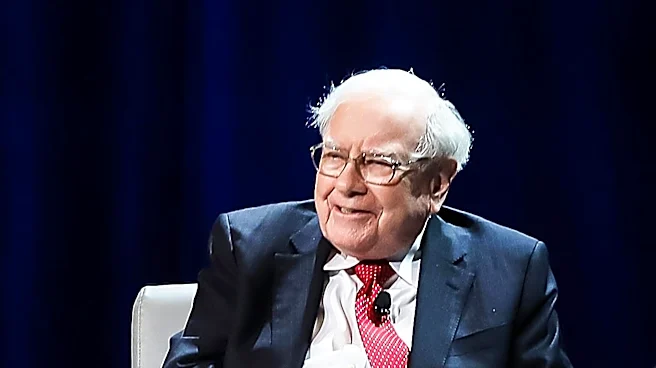
Argus Research has downgraded Berkshire Hathaway to 'hold' from 'buy' after the conglomerate's stock surpassed Argus's $550 price target earlier this month. Berkshire Hathaway, led by Warren Buffett, has seen a more than 6% increase in its stock price over
the past month, closing at $572.04 per share on Thursday. Argus analysts Kevin Heal and Shutaro Yasuda attribute these recent gains to Berkshire's significant share repurchases and its popularity as an 'anti-AI trade'—an investment not directly tied to the booming artificial intelligence sector. The firm now considers Berkshire's stock 'fully valued,' trading at approximately 25 times Argus's 2027 estimate for operating earnings per share. Argus indicated it would reconsider a 'buy' rating if the stock fell below 1.5 times its book value; its current price-to-book ratio is 1.60.
Why It's Important?
This downgrade from Argus Research signals a shift in investment sentiment towards Berkshire Hathaway, suggesting that its recent rally may have peaked in the short term. For investors, this implies that the stock's current valuation might not offer significant upside potential, prompting a more cautious approach. The 'anti-AI trade' phenomenon highlights a broader market dynamic where some investors are seeking refuge in traditional value stocks, like those held by Berkshire Hathaway (e.g., Coca-Cola, Chevron, American Express), as a counterbalance to the high-growth, high-valuation AI sector. This trend reflects a diversification strategy and a potential concern about the sustainability of the AI boom. Berkshire's substantial share repurchases, totaling $9.6 billion in the third quarter alone, have also played a crucial role in boosting its stock price, demonstrating management's confidence in the company's intrinsic value.
What's Next?
Investors will likely monitor Berkshire Hathaway's stock performance closely, particularly its price-to-book ratio, to see if it drops below the 1.5 times threshold that Argus Research would consider for a 'buy' rating. The company's continued share repurchase program could provide some support for the stock, but the pace and scale of these buybacks will be key. The broader market's sentiment towards AI and traditional value stocks will also influence Berkshire's trajectory. If the 'anti-AI trade' continues to gain traction, Berkshire could maintain its appeal, but if the AI sector experiences a renewed surge, investor focus might shift away. Future earnings reports and any changes in Berkshire's investment portfolio, such as further adjustments to its Apple or Alphabet holdings, will also be critical factors for analysts and investors.
Beyond the Headlines
The 'anti-AI trade' narrative surrounding Berkshire Hathaway reveals a deeper market psychology at play: a search for stability and tangible value amidst technological disruption. While AI promises transformative growth, it also introduces uncertainty and speculative bubbles, leading some investors to favor companies with established business models and consistent cash flows. Berkshire's portfolio, with its mix of insurance, railway, and consumer goods, represents a hedge against the volatility of tech-driven markets. This trend could signify a broader re-evaluation of investment strategies, where fundamental value and proven profitability are increasingly prioritized. It also underscores the enduring influence of Warren Buffett's investment philosophy, which emphasizes long-term value and disciplined capital allocation, even in an era dominated by rapid technological advancements.