






What's Happening?
MicroFactory, a robotics company, has developed an assembly model that can be retrained for approximately $5 per session. This low cost is attributed to making the model small enough to operate on a Jetson Nano. Igor Kulakov, co-founder and CEO of MicroFactory, explained
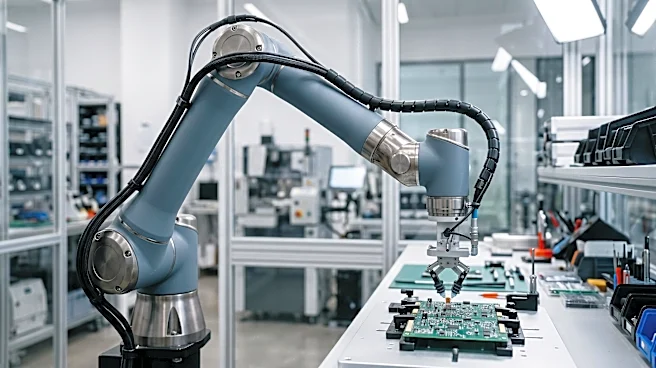
that traditional reinforcement learning for assembly can be unreliable, potentially damaging materials and robots, and taking extensive time to perfect. To counter this, MicroFactory employs a correction loop where a human intervenes when the robot makes an error, and the model is subsequently retrained based on that correction. This method reportedly brings their assembly reliability close to 100%. Kulakov highlighted that the ability to frequently fix edge cases due to the low retraining cost is a significant advantage. The company recently demonstrated a single-arm cell assembling a gadget every 7 minutes for 2.5 hours continuously until it ran out of parts. A single-arm cell from MicroFactory starts at $11,950.
Why It's Important?
This development by MicroFactory could significantly impact the robotics and manufacturing sectors by making automated assembly more accessible and reliable. The low cost of retraining addresses a major hurdle in robotics adoption: the expense and time associated with error correction and adaptation to new tasks. By reducing retraining costs to just $5, MicroFactory enables companies to rapidly iterate and improve robot performance, making automation more practical for a wider range of applications, including those with frequent changes or complex assembly requirements. This could lead to increased efficiency, reduced waste from damaged materials, and faster deployment of robotic solutions. Smaller businesses, which might have been deterred by the high costs of traditional robotics, could find MicroFactory's approach more feasible, potentially democratizing access to advanced automation technologies and fostering innovation in manufacturing processes across various industries.
What's Next?
The low-cost retraining model developed by MicroFactory is likely to encourage broader adoption of their robotic assembly cells, particularly among manufacturers seeking cost-effective automation solutions. Other robotics companies may explore similar strategies to reduce retraining expenses, potentially leading to a shift in industry standards for robot deployment and maintenance. As MicroFactory continues to refine its technology, it could expand its offerings to more complex assembly tasks or integrate with other manufacturing processes. The success of this model might also spur further research into efficient, low-resource AI models for robotics, driving innovation in edge computing and embedded AI. Businesses considering automation will likely evaluate the total cost of ownership, including retraining, making MicroFactory's approach a compelling option in the competitive robotics market.
Beyond the Headlines
The innovation from MicroFactory highlights a broader trend in artificial intelligence and robotics: the move towards more practical, cost-efficient, and adaptable systems. By focusing on a human-in-the-loop correction mechanism and low-cost retraining, MicroFactory is addressing the inherent challenges of deploying AI in real-world, dynamic environments. This approach underscores the importance of human-AI collaboration, where human oversight and intervention are crucial for refining AI models and ensuring reliability, rather than aiming for fully autonomous systems from the outset. Ethically, this model could lead to more responsible AI deployment by ensuring that human expertise remains central to the learning process, potentially mitigating risks associated with fully autonomous decision-making in critical manufacturing tasks. It also suggests a future where AI tools are not just powerful but also highly flexible and economically viable for continuous improvement.