



What's Happening?
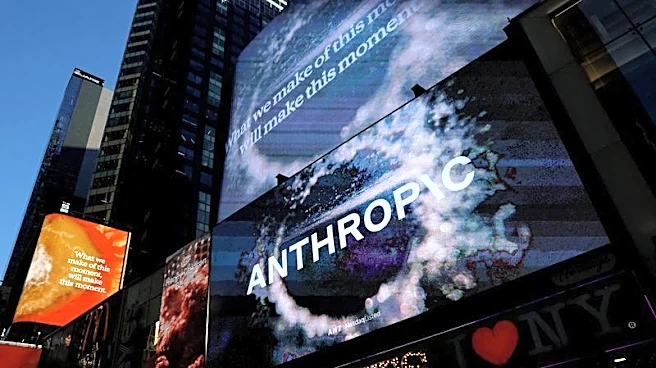
Anthropic, an artificial intelligence company, experienced significant volatility during its initial public offering (IPO), leading to a sharp decline in its market value. On its second day of trading, Anthropic lost approximately $109 billion of its market value. The
stock dropped as much as 15% on Friday, briefly trading just 5 cents above its IPO price, before closing down 8.5% at $88.91. Despite this, shares remained 7% above the IPO price. The turbulent debut has prompted a 'blame game' on Wall Street, with investors and observers pointing fingers at various factors, including angry fund managers who were excluded from the offer, shortcomings by underwriters, and the broader climate for artificial intelligence stocks. According to The Wall Street Journal, more than half of the $81 billion in IPO shares were allocated to existing investors like Altimeter Capital, Lightspeed Venture Partners, and Menlo Ventures, an effort by Anthropic to reward early backers. This allocation strategy has drawn scrutiny, as venture capital firms are typically not granted substantial IPO share allotments that could be sold for immediate gains.
Why It's Important?
The tumultuous IPO of Anthropic highlights the inherent risks and complexities within the U.S. financial markets, particularly for high-profile technology companies. The significant market value plunge and the subsequent 'blame game' could impact investor confidence in future AI-related IPOs, potentially making it more challenging for other AI startups to raise capital through public offerings. The scrutiny over share allocation, where existing investors received a large portion of IPO shares while many other firms received nothing, raises questions about fairness and transparency in the IPO process. This could lead to calls for regulatory review or changes in how IPOs are structured, affecting investment banks and venture capital firms. The situation also underscores the volatile nature of the artificial intelligence stock market, where investor sentiment can shift rapidly, impacting the valuations of even well-funded companies. This event could influence how venture capital firms approach their investments and exit strategies, as the immediate gains from IPOs may not always materialize as expected.
What's Next?
The aftermath of Anthropic's turbulent IPO is likely to involve continued discussions and potential investigations into the share allocation process and the factors contributing to the market value plunge. Investors and market observers will be closely watching Anthropic's stock performance in the coming weeks and months to see if it stabilizes or continues to experience volatility. The company's decision to allow some current and former employees to immediately sell approximately 300 million shares, a departure from typical lockup agreements, may also face further examination. This could lead to a reevaluation of lockup policies in future IPOs across the industry. The broader artificial intelligence sector will also be under increased scrutiny, with investors potentially becoming more cautious about valuations and growth prospects. Underwriters involved in the Anthropic IPO may face pressure to explain their strategies and address concerns raised by excluded fund managers, potentially influencing future underwriting practices.
Beyond the Headlines
The Anthropic IPO saga extends beyond immediate financial implications, touching upon deeper ethical and structural issues within the venture capital and public markets. The practice of heavily allocating IPO shares to existing investors, while intended to reward early backers, can create an uneven playing field and potentially alienate new investors. This raises questions about the democratization of investment opportunities and whether the current system unduly favors established players. Furthermore, the rapid and significant loss of market value for a prominent AI company could trigger a broader re-evaluation of the 'AI bubble' narrative. It might prompt a more critical assessment of AI company valuations, moving beyond hype to focus on sustainable business models and profitability. This event could also fuel debates about the role of venture capital in shaping market dynamics and the potential for conflicts of interest when firms act as both early investors and beneficiaries of IPO allocations. The long-term impact could be a shift towards more stringent regulations or industry best practices to ensure greater transparency and fairness in the IPO process.