




What's Happening?
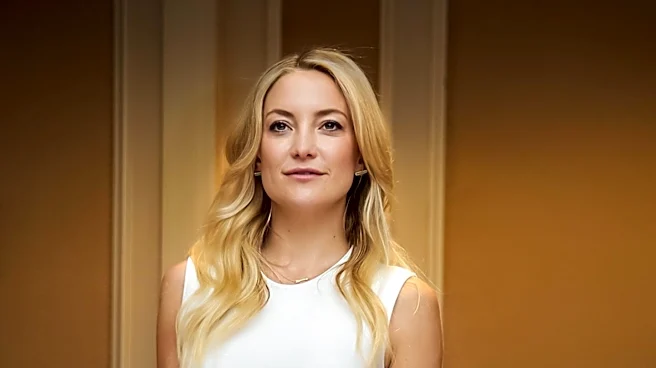
Actress Kate Hudson has openly discussed her disinterest in formal wedding planning, despite being engaged to Danny Fujikawa since 2021. During an episode of her podcast 'Sibling Revelry,' Hudson shared her concerns about the financial burden and logistical
complexities associated with weddings. She noted that her family alone comprises around 50 people, making a small wedding difficult to achieve. Hudson also expressed a preference for remaining engaged indefinitely, valuing her freedom over the 'contractual thing' of marriage. This sentiment echoes previous statements she made on Drew Barrymore's talk show last year, where she highlighted the significant cost and effort involved in planning a wedding. Hudson's parents, Goldie Hawn and Kurt Russell, who have been together for over 40 years without marrying, serve as a personal example for her perspective on long-term commitment outside of traditional marriage.
Why It's Important?
Kate Hudson's public stance on marriage and wedding planning reflects a growing trend among individuals, particularly in the public eye, who are re-evaluating traditional marital norms. Her comments about the high costs associated with weddings resonate with many Americans facing economic pressures, potentially influencing societal perceptions of marriage as a necessary milestone. The emphasis on personal freedom and the example set by her parents, Goldie Hawn and Kurt Russell, challenge conventional expectations of relationships and commitment. This perspective could empower others to consider alternative relationship structures that prioritize individual autonomy and financial practicality over societal traditions. For the wedding industry, such celebrity endorsements of less formal or non-marital commitments could signal a shift in consumer preferences, potentially leading to a greater demand for smaller, more intimate celebrations or even a decline in elaborate wedding expenditures.
What's Next?
While Hudson has expressed her reluctance, it remains to be seen if she and Danny Fujikawa will eventually opt for a low-key celebration or continue their engagement indefinitely. Her public statements may encourage more open discussions about the pressures and expectations surrounding marriage and weddings in contemporary society. This could lead to a broader acceptance of diverse relationship models and a re-evaluation of what constitutes a committed partnership. The ongoing dialogue might also prompt the wedding industry to adapt by offering more flexible and cost-effective options to cater to evolving consumer preferences. Ultimately, Hudson's decision, whatever it may be, will likely continue to fuel conversations about modern relationships and the evolving definition of commitment.
Beyond the Headlines
Hudson's candidness about her views on marriage touches upon deeper societal shifts regarding personal freedom, financial pragmatism, and the redefinition of family structures. Her reference to the 'contractual thing' highlights a critical perspective on the legal and social implications of marriage, suggesting a desire to maintain autonomy within a committed relationship. This viewpoint challenges the traditional notion that marriage is the ultimate expression of love and commitment, instead proposing that enduring partnerships can thrive without formal legal ties. The influence of her parents' long-standing, unmarried relationship further underscores a cultural evolution where personal happiness and compatibility are prioritized over conventional societal expectations. This trend could lead to a broader re-examination of the legal and social benefits traditionally associated with marriage, potentially impacting areas such as inheritance laws, partnership rights, and societal recognition of diverse family units.