



What's Happening?
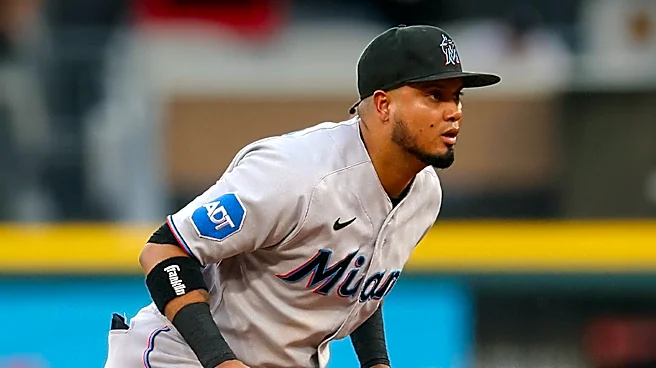
Luis Arraez's exceptional 2026 season, marked by a significant defensive turnaround, has positioned him as a strong candidate for a multiyear contract in the 2027 MLB free agency. His fielding runs above average ranked in the 91st percentile, a substantial
improvement from the 3rd percentile in the previous year. Offensively, Arraez maintained his elite contact hitting, posting a .310/.345/.419 slash line with 6 home runs and 64 RBIs in 151 games. However, the sustainability of his defensive gains and whether his contact-first, low-power, and low-walk profile fits team lineups remain key considerations for potential suitors. While he is expected to command a higher contract than his previous one-year 'prove-it' deal, uncertainty about his defense could lead teams to offer shorter-term contracts with high annual values.
Why It's Important?
Arraez's free agency presents a critical decision point for MLB teams, as they must weigh his proven elite contact hitting against the question marks surrounding his defensive consistency and limited power. His unique offensive profile, characterized by a high batting average and low strikeout rate, is a valuable asset in today's game, but it may not align with every team's strategic needs, particularly those seeking more home-run production. The market's response to Arraez will indicate how teams prioritize different offensive and defensive attributes. If his defensive improvement is deemed sustainable, he could secure a more lucrative long-term deal. Conversely, if skepticism persists, he might receive short-term, high-AAV offers, reflecting a cautious approach by clubs. This situation highlights the ongoing debate in baseball analytics regarding the optimal balance between contact, power, and defensive versatility.
What's Next?
Luis Arraez's free agency will see various MLB teams, including the Yankees, Blue Jays, Giants, Tigers, Diamondbacks, and Royals, evaluating his fit within their rosters. Each team will assess his defensive sustainability and offensive profile against their specific needs and financial constraints. For instance, teams like the Blue Jays, who are looking to add power, might find his contact-first approach less ideal. His preference to play second base could also complicate negotiations if his defense regresses. The outcome will likely be a contract that reflects the perceived risk and reward of his unique skill set, potentially a short-term deal with a high annual value. The decisions made by these teams will not only shape their own rosters but also influence the broader free-agent market for players with similar profiles.
Beyond the Headlines
The case of Luis Arraez underscores the dynamic nature of player valuation in professional baseball. His dramatic defensive improvement in a single season highlights the potential for players to evolve and increase their market worth beyond their established offensive or defensive reputations. This phenomenon can be attributed to factors such as specialized coaching, changes in team environment, or personal dedication. Arraez's situation also brings to light the strategic dilemma for teams: whether to invest heavily in a player whose value is heavily concentrated in one elite skill (contact hitting) and whose other skills (power, defense) have either been historically inconsistent or recently improved. The resolution of his free agency will offer insights into how MLB front offices balance past performance, recent improvements, and future projections in their player acquisition strategies.