
What's Happening?
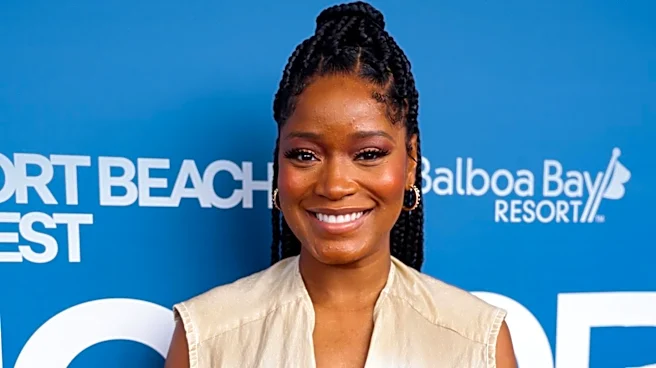
Keke Palmer recently clarified her previous statements regarding her sexuality, asserting that she does not identify as asexual despite earlier remarks. During an appearance on the 'Tea Time' podcast, co-hosted by Raven Symoné and Miranda Pearman-Maday,
Palmer explained that her earlier comment about being '100% sure' she was asexual was made in jest and not meant to be taken literally. She elaborated that she simply doesn't feel as sexual as societal norms might suggest is 'normal.' Palmer further detailed that her attraction to individuals is primarily triggered by mental stimulation and a strong 'vibe.' She noted that if a relationship lacks mental engagement, her sensual connection diminishes, leading her to view the person as an 'inanimate object.' This clarification comes after an Instagram post where she reflected on a non-romantic Valentine's Day, which initially led to her self-classification as asexual.
Why It's Important?
Palmer's candid discussion about her sexuality and attraction preferences is significant as it contributes to a broader conversation about the diverse spectrum of human sexuality, particularly in a culture often perceived as hypersexualized. Her emphasis on mental stimulation over physical attraction challenges conventional narratives of intimacy and desire, potentially resonating with individuals who experience attraction similarly. This public dialogue, especially from a prominent figure like Palmer, can help normalize varied sexual experiences and orientations, fostering greater understanding and acceptance. It also highlights the pressure individuals may feel to conform to societal expectations regarding sexuality, and her willingness to articulate her unique experience can empower others to define their own sexual identities without external pressure. The conversation underscores the idea that sexuality is complex and deeply personal, extending beyond simple labels.
What's Next?
Palmer's clarification is likely to continue sparking discussions among her fanbase and in wider cultural commentary regarding sexuality and personal identity. Her openness may encourage more public figures to share their own experiences, further diversifying the representation of sexual orientations in media. This could lead to increased awareness and education about different forms of attraction, including demisexuality or other nuanced experiences that prioritize emotional or intellectual connection. The dialogue might also prompt a re-evaluation of how sexuality is portrayed and discussed in popular culture, moving towards more inclusive and less prescriptive definitions. For Palmer herself, this clarification solidifies her stance on a personal matter, allowing her to continue her career with a clearer public understanding of her identity.
Beyond the Headlines
Beyond the immediate news of Palmer's clarification, her statements touch upon deeper societal implications concerning authenticity and vulnerability in the public eye. Growing up in front of the camera, Palmer noted her comfort with 'public vulnerability' but acknowledged difficulties with interpersonal intimacy. This distinction highlights the unique challenges faced by public figures in forming genuine connections in a transactional world. Her struggle to maintain genuine connections, whether romantic or platonic, in a society that often prioritizes superficial interactions, reflects a broader sentiment of isolation and the difficulty of fostering deep relationships. Her experience underscores the ethical dimension of public discourse around personal identity, where initial, perhaps joking, remarks can be taken literally and lead to widespread misinterpretation, necessitating further clarification.