



What's Happening?
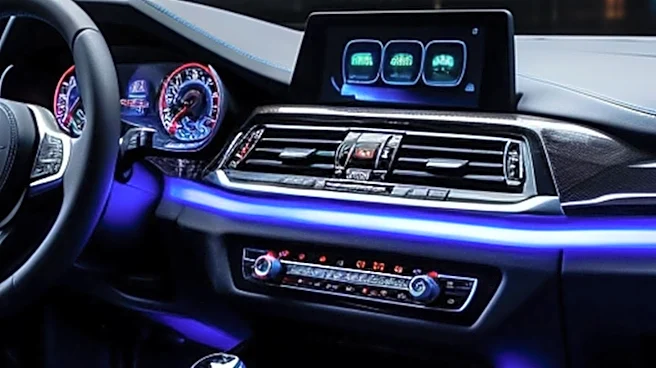
The market for car ambient lighting kits is expanding, offering vehicle owners new ways to personalize their car interiors. These kits provide modern, dynamic lighting effects, often controllable via smartphone applications. Key features include an extensive
color palette, scene creation capabilities, and music synchronization, where lights react to the rhythm of music through a built-in microphone. The technology primarily uses acrylic LED strips, which distribute light uniformly and intensely, or fiber optics, which are particularly effective for specialized applications like starlight headliners. Installation methods are becoming more non-invasive, with systems designed to fit into existing gaps in dashboards and door panels, avoiding the need for drilling or strong adhesives. Universal kits operating on a standard 12V power supply are widely available, ensuring compatibility across various car models.
Why It's Important?
The rise of advanced car ambient lighting kits signifies a growing trend in vehicle customization, moving beyond traditional aesthetic upgrades to integrated technological enhancements. This trend impacts the automotive aftermarket industry by creating demand for sophisticated lighting solutions that offer both visual appeal and interactive features. For consumers, these kits provide an opportunity to personalize their driving environment, potentially enhancing comfort and the overall driving experience. The emphasis on non-invasive installation and universal compatibility makes these upgrades accessible to a broader range of car owners, reducing barriers to entry for customization. The integration of smartphone control and music synchronization also reflects the broader consumer expectation for seamless connectivity and personalized digital experiences within their vehicles, pushing manufacturers to innovate in smart car accessories.
What's Next?
The future of car ambient lighting is likely to see further advancements in integration and smart features. Manufacturers may focus on developing more sophisticated algorithms for music synchronization, offering more nuanced and responsive light patterns. There could also be an increased emphasis on seamless integration with existing vehicle infotainment systems, allowing for centralized control and customization. As technology progresses, we might see more energy-efficient LED solutions and even more discreet installation methods that make the lighting appear as an intrinsic part of the car's design rather than an add-on. The market may also explore adaptive lighting systems that respond to external conditions, such as time of day or weather, to automatically adjust interior ambiance, further enhancing the driving experience and setting new standards for in-car personalization.
Beyond the Headlines
Beyond the immediate aesthetic and technological appeal, the evolution of car ambient lighting touches upon deeper aspects of human-machine interaction and the psychological impact of environment. The ability to dynamically change the interior lighting of a car can influence driver mood, reduce fatigue, and even enhance safety by creating a more comfortable and less distracting environment. This personalization reflects a broader societal desire for customizable spaces that adapt to individual preferences and emotional states. The subtle interplay of light and color within a confined space like a car interior can transform a mundane commute into a more engaging and personalized journey, blurring the lines between functional transportation and a personalized mobile sanctuary. This trend highlights how technology is increasingly being used to cater to emotional well-being and individual expression, even in utilitarian contexts.