






What's Happening?
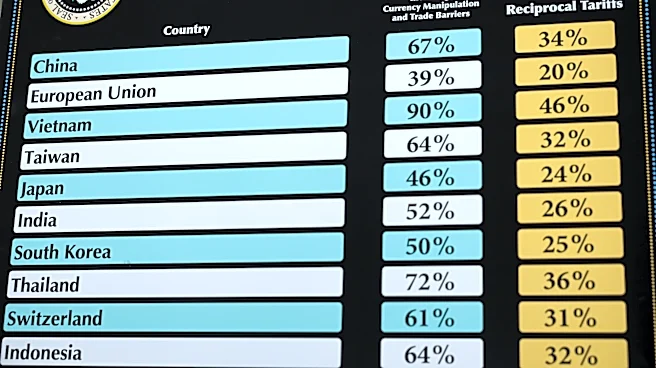
American Eagle Outfitters (AEO) and Gap Inc. (GAP), prominent specialty apparel retailers, are navigating differing impacts from tariff policies. AEO recently benefited from a one-time tariff refund due to a court ruling, providing a positive boost to its
financial performance. In contrast, GAP anticipates a modest near-term tariff headwind, indicating ongoing cost pressures. This divergence highlights how tariff exposure can uniquely affect companies within the same sector. AEO has shown stronger recent market momentum, driven by its faster-growing Aerie and OFFLINE segments, along with shareholder-return and tariff-refund catalysts. GAP, while larger in scale and possessing a stronger balance sheet, is focused on a multi-year turnaround, with its performance reflecting steadier comparable-sales consistency. The market is currently weighing AEO's momentum against GAP's stability and turnaround efforts, with AI analysis from Tickeron favoring AEO in the current environment due to its stronger price trend and growth segments.
Why It's Important?
The differing tariff impacts on AEO and GAP underscore the complex and often unpredictable nature of trade policies on U.S. retailers. While AEO gained from a tariff refund, GAP's expected tariff headwind illustrates how such policies can directly influence merchandise margins and operational costs. This situation is critical for investors and stakeholders as it highlights the importance of understanding a company's specific exposure and ability to mitigate or capitalize on trade policy shifts. The broader U.S. retail sector, particularly apparel, is sensitive to import costs, and tariffs can either erode profitability or, in AEO's case, provide unexpected financial benefits. The market's preference for AEO's momentum over GAP's stability also reflects a broader investor appetite for growth-oriented companies, even as larger, more established brands work through turnarounds. This dynamic affects not only the companies themselves but also the thousands of employees, suppliers, and consumers who interact with these retail giants.
What's Next?
For American Eagle Outfitters, the focus will likely be on sustaining the growth of its Aerie and OFFLINE brands and how effectively it can manage marketing costs and margin sensitivity. The company's ability to continue leveraging favorable resolutions to tariff-related claims will also be crucial. For Gap Inc., the immediate future involves navigating the anticipated tariff headwinds and continuing its multi-year turnaround strategy. Investors will closely monitor its ability to maintain comparable-sales consistency and leverage its strong cash position. Both companies will also be influenced by evolving consumer spending patterns and the broader economic environment, especially as the retail sector enters key shopping seasons. The ongoing impact of trade policies and their potential for either refunds or additional costs will remain a significant factor for both retailers.
Beyond the Headlines
The contrasting experiences of AEO and GAP with tariffs reveal a deeper implication for the U.S. business landscape: the uneven application and resolution of trade policies. While tariffs are often implemented with broad economic goals, their real-world impact can be highly granular, creating winners and losers even within the same industry. AEO's tariff refund, stemming from a court ruling, highlights the legal complexities and potential for retroactive adjustments in trade disputes. This suggests that companies with robust legal and compliance departments may be better positioned to navigate and even benefit from such intricacies. Conversely, GAP's ongoing tariff headwind points to the persistent cost pressures that can burden retailers, potentially leading to higher consumer prices or reduced profit margins. This situation also underscores the need for businesses to build resilience against unpredictable policy shifts, influencing sourcing strategies, supply chain management, and overall financial planning.