





What's Happening?
PATEO, a Tier 1 supplier in intelligent cockpits and connected vehicle technologies, has signed a strategic cooperation Memorandum of Understanding (MoU) with Arm, a global leader in computing platforms. This partnership aims to advance innovation in physical
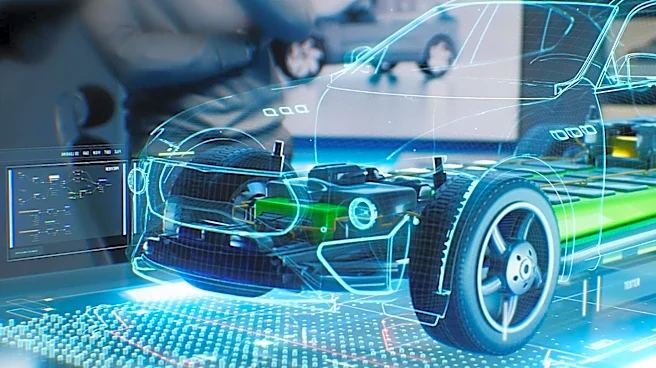
AI, specifically focusing on next-generation AI-enabled workloads for the automotive industry. The collaboration will explore solutions that enable perception-driven and interaction-driven intelligence in vehicles. Physical AI is described as a new phase of industrial deployment where intelligent agents interact with the physical world in real-time, allowing machines to perceive, understand, decide, and act autonomously in complex environments. Automobiles are identified as a key platform for this evolution, moving beyond traditional in-vehicle AI applications to more sophisticated scenarios like multimodal perception and cockpit-driving integration.
Why It's Important?
This strategic partnership is significant for the U.S. automotive industry and the broader technology sector. The advancement of physical AI in vehicles promises to revolutionize transportation, enhancing safety, efficiency, and the overall user experience. For U.S. consumers, this could mean more intelligent, autonomous, and personalized driving experiences. For American businesses, particularly those involved in automotive manufacturing, software development, and AI, this collaboration signals a push towards cutting-edge innovation and potentially new market opportunities. The focus on robust computing platforms with low power consumption, real-time responsiveness, reliability, and functional safety is crucial for the widespread adoption of advanced AI in vehicles. This development underscores the increasing importance of AI as a competitive differentiator in the global automotive market and highlights the need for collaborative ecosystems to drive complex technological advancements.
What's Next?
The collaboration between PATEO and Arm will focus on deepening innovation across the physical AI stack, from IP and chips to operating systems, algorithms, applications, and cloud platforms. This will involve exploring new solutions for AI-enabled workloads in automotive, with an emphasis on perception-driven and interaction-driven intelligence. PATEO's 'AI-Defined Vehicles' development philosophy, coupled with Arm's expertise in automotive technologies and ecosystem, is expected to accelerate the commercialization and deployment of physical AI technologies in vehicles. The partnership aims to drive the evolution of intelligent vehicles towards more advanced levels of intelligence, ultimately delivering safer, smarter, and more efficient mobility experiences globally. Continued investment in physical AI and open ecosystem collaboration will be key to realizing these advancements.
Beyond the Headlines
The move towards 'AI-Defined Vehicles' and the broader concept of physical AI raise profound implications for society, ethics, and regulation. As vehicles become more autonomous and capable of real-time interaction with their environment, questions of liability in accidents, data privacy, and the ethical decision-making frameworks embedded in AI systems become paramount. The integration of AI into critical functions like perception and control necessitates rigorous testing, transparency, and robust regulatory oversight to ensure public safety and trust. Furthermore, the increasing sophistication of in-vehicle AI could transform urban planning, infrastructure development, and even the nature of human-machine interaction, potentially leading to new forms of mobility and societal organization. The success of this technological shift will depend not only on technical innovation but also on addressing these complex societal and ethical considerations.