
What's Happening?
Oklo Inc., an advanced nuclear technology company, has updated the projected operational timeline for its first Aurora powerhouse in Idaho, now anticipating it to come online in 2028 or 2029. This adjustment
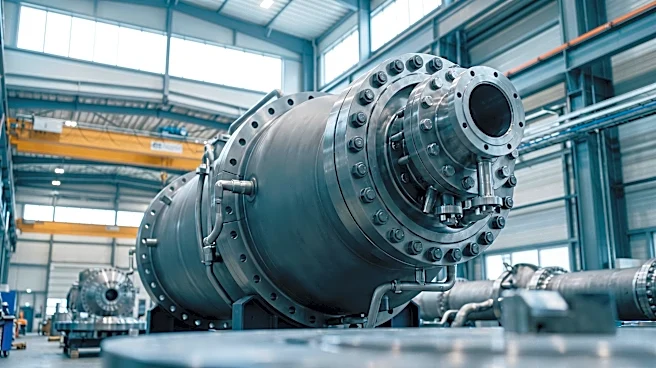
was announced during the company's third-quarter 2026 earnings call. CEO Jake DeWitte cited lessons learned from Oklo's Groves-1 test reactor, emphasizing the need for schedule flexibility to accommodate equipment calibration, testing, and integration. Despite the revised timeline, construction, fuel fabrication, and regulatory work are progressing in parallel. The Department of Energy has approved the project's preliminary documented safety analysis, a key milestone supporting safety-related construction and procurement. Oklo reported a net loss of $123.3 million for the first nine months of 2026 but held $3.1 billion in cash, cash equivalents, and marketable securities as of September 30, bolstered by $2.3 billion raised through at-the-market offerings. The company also announced a manufacturing agreement with U.S. Forged Rings for large reactor components, aiming to secure supply chain capacity for future deployments.
Why It's Important?
This timeline adjustment for Oklo's Aurora reactor is significant for the advanced nuclear energy sector and the broader U.S. energy landscape. While a delay, it reflects a pragmatic approach to complex nuclear technology deployment, prioritizing thorough testing and integration, which is crucial for safety and long-term operational reliability. The company's substantial cash reserves, totaling $3.1 billion, provide a strong financial cushion to navigate these extended development phases without immediate capital constraints, reassuring investors about its ability to fund operations despite ongoing losses. The manufacturing agreement with U.S. Forged Rings underscores a strategic effort to build a robust domestic supply chain for advanced nuclear components, which is vital for national energy independence and reducing reliance on foreign suppliers. This move could also stimulate growth in U.S. manufacturing and create specialized jobs. Furthermore, Oklo's continued pursuit of a 1.2-gigawatt power campus in Ohio under an agreement with Meta highlights the growing interest from data centers and other energy-intensive industries in reliable, carbon-free power sources, signaling a potential shift in how large-scale energy consumers procure electricity.
What's Next?
Oklo Inc. will continue advancing construction at its Aurora-ID site, with reactor-area excavation complete and structural steel installation underway. Key upcoming milestones include the approval of the documented safety analysis, a readiness review, and startup authorization, with the safety analysis expected to move forward closer to construction completion, likely in 2028. The company is targeting its first full fuel assembly in 2027 from its Aurora Fuel Fabrication Facility (A3F). Oklo also plans to commission a recycling pilot facility in 2027, begin construction on its Groves-2 facility, and complete its first contracted isotope delivery. For its Ohio project with Meta, the company will proceed through PJM's interconnection process, which is estimated to take place over the next 24 months. Investors will closely monitor further updates on the Aurora-INL reactor's cost guidance and the finalization of a binding power agreement with Meta, as these will be central to market sentiment and the company's future revenue streams. Oklo also aims to generate early third-party fuel-services revenue within the next two years.
Beyond the Headlines
The revised timeline for Oklo's Aurora reactor, while a practical adjustment, highlights the inherent complexities and extended development cycles characteristic of advanced nuclear technology. This situation underscores the significant capital investment and regulatory hurdles involved in bringing novel energy solutions to market, even with substantial financial backing. The company's emphasis on thorough testing and integration, informed by its Groves-1 test reactor, reflects a commitment to safety and operational excellence, which is paramount in the nuclear industry. This methodical approach could set a precedent for other advanced reactor developers, potentially influencing regulatory expectations and industry best practices. Furthermore, Oklo's strategy to own and operate its powerhouses, directly selling power to customers like data centers, represents a disruptive business model in the energy sector. This direct-to-consumer approach could bypass traditional utility structures, offering a more direct path for large energy users to access carbon-free power and potentially accelerating the decarbonization of energy-intensive industries. The long-term success of this model could reshape energy procurement strategies for major corporations and influence future grid infrastructure development.