








What's Happening?
West Fraser Timber Co. Ltd., a major North American wood products company, has announced the indefinite curtailment of two of its U.S. operations: the Huguley OSB Mill and the Leola Lumber Mill. This decision comes in response to a challenging market
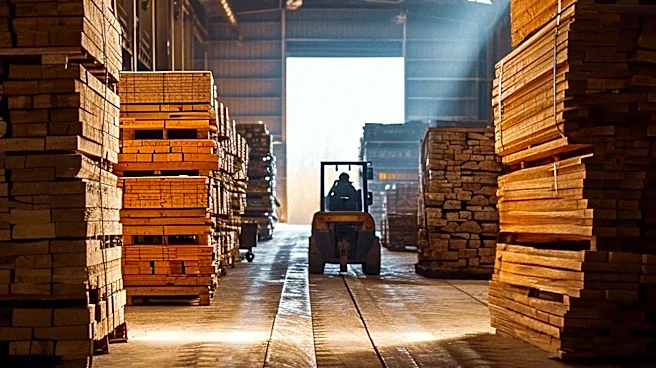
environment characterized by weak lumber and oriented strand board (OSB) demand, softer housing activity, and elevated operating costs. The Huguley mill produces OSB, a critical material for residential construction, while the Leola mill produces lumber for construction and renovation. These curtailments are part of West Fraser's strategy to align production with current demand and concentrate output at its most efficient facilities. Despite these operational challenges and continued net losses, West Fraser's shares have shown resilience over the past year, attributed to its strong balance sheet and diversified product mix, which provide a buffer against market downturns. The company's actions are seen as a bellwether for the broader forestry and building materials sector, indicating how the industry is adapting to changing demand.
Why It's Important?
The indefinite curtailment of West Fraser's U.S. mills signifies the ongoing difficulties within the U.S. housing and construction sectors. As one of the largest lumber and OSB producers in North America, West Fraser's production decisions directly reflect the health of the building materials market. Reduced demand for OSB and lumber, driven by softer housing starts, impacts the entire supply chain, from raw material suppliers to homebuilders. These curtailments aim to reduce oversupply in the market, which could eventually help stabilize prices and improve margins for the industry. However, in the short term, they indicate a contraction in available building materials, potentially affecting construction timelines and costs once demand rebounds. The resilience of West Fraser's stock, despite these challenges, suggests that investors are looking beyond the current downturn, anticipating a recovery in the cyclical lumber and OSB markets, especially as industry-wide capacity cuts could lead to tighter supply in the future.
What's Next?
The immediate future for West Fraser and the broader wood products industry will largely depend on a recovery in U.S. housing activity and a stabilization of borrowing costs. Industry-wide capacity cuts, including those by West Fraser, are expected to tighten supply, which could lead to improved market conditions and margin recovery once demand picks up. However, continued net losses could strain cash flow if the downturn persists longer than anticipated. Additionally, new U.S. trade measures on softwood lumber imports could further impact Canadian-made products sold into the American market, although West Fraser's significant U.S. manufacturing base offers some protection. The company will likely continue to monitor market conditions closely, potentially implementing further adjustments to its production capacity if demand does not improve. The long-term outlook is influenced by trends such as the shift towards sustainable building materials and the persistent housing shortage in North America, which could drive demand for wood products in the future.
Beyond the Headlines
The curtailment of West Fraser's U.S. mills highlights a broader economic dynamic where cyclical industries like building materials are highly sensitive to macroeconomic factors such as interest rates and housing market health. This situation underscores the delicate balance companies must maintain between managing current operational costs and positioning for future growth. The market's optimistic view of West Fraser, despite current losses, reflects an understanding of these cyclical patterns and the company's strategic advantages, such as its strong balance sheet and diversified product portfolio. This scenario also brings to light the increasing importance of sustainable building practices, as wood is increasingly seen as a renewable, lower-carbon alternative to traditional materials. The long-term demand drivers, including the housing shortage and the sustainable building shift, suggest that while the industry faces immediate headwinds, its fundamental role in construction and development remains strong, potentially leading to a robust recovery when economic conditions improve.