
What's Happening?
Nvidia's increasing market capitalization has led to a significant concentration within the S&P 500 index. The S&P 500 is weighted by float-adjusted market capitalization, meaning companies with higher
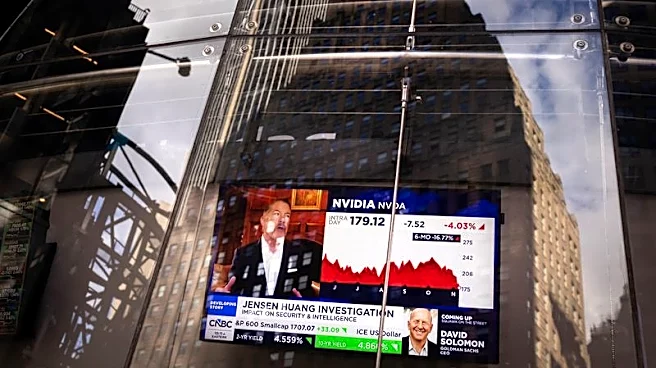
tradable market values hold larger portions of the index. Nvidia's stock performance has caused its weight in the index to fluctuate daily, reflecting its share price movements relative to other companies. The company first surpassed a $4 trillion market value on July 9, 2025, and became the first public company to reach $5 trillion on October 29, 2025. This substantial market value translates directly into a heavy presence in any cap-weighted index, raising concerns about concentration risk, where the index's return becomes heavily dependent on the performance of a few top stocks.
Why It's Important?
This concentration is critical for U.S. investors, particularly those holding S&P 500 index funds. When a few stocks, like Nvidia, constitute a large portion of the index, their performance disproportionately impacts the overall index's return. A significant drop in a top holding can move the entire benchmark more than a decline in a smaller company. For example, on September 30, Nvidia represented approximately 8.3% of the S&P 500, and the top 10 companies collectively accounted for nearly 40%. This means investors in S&P 500 funds are automatically making substantial bets on these individual stocks, whether intentionally or not. This scenario increases the risk of portfolio volatility tied to the fortunes of a select few companies.
What's Next?
The discussion around S&P 500 concentration is prompting investors to reconsider their allocation strategies. While the S&P 500 remains a compelling way to invest in leading U.S. businesses, the changing leadership and increased concentration risk suggest potential shifts in investment approaches. Some investors may explore equal-weighted ETFs, which reduce concentration by assigning each company roughly 0.2% at each quarterly rebalance, making no single business more influential than another. Other strategies, like the Tema S&P 500 Historical Weight ETF Strategy (DSPY), aim to lower concentration risk without completely diluting the impact of larger companies. These alternative approaches seek to mitigate the impact of sharp declines in mega-cap stocks, which have become more common, as seen with Meta, Amazon, Microsoft, and Alphabet.
Beyond the Headlines
The evolving concentration within the S&P 500 highlights a fundamental tension in market-cap-weighted indexing: while it efficiently reflects the market's collective judgment of company value, it can also lead to significant exposure to single-stock risk. This phenomenon has historical precedents, with companies like IBM, AT&T, and technology stocks during the dot-com era holding outsized weights. The current situation with Nvidia underscores that market leadership is dynamic; companies driving growth change over time. This continuous rotation means that even as the broader market advances, individual leaders can lose ground, and new ones emerge. Understanding this dynamic is crucial for investors to navigate the long-term shifts in the U.S. equity landscape and manage portfolio risk effectively.