





What's Happening?
Eugene Investment & Securities predicts that the demand for semiconductor equipment will continue its upward cycle beyond 2027 and into 2028, potentially extending through 2030. This optimistic outlook persists despite concerns about a potential decline
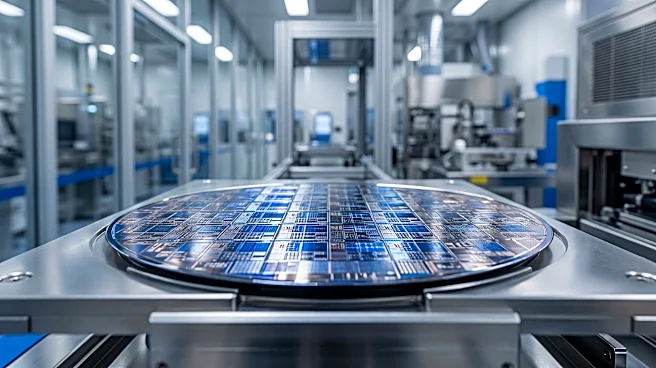
in memory prices and a slowdown in certain demand areas. The primary driver for this sustained growth is the expanding investment in artificial intelligence (AI), which necessitates increased chip production capacity. Son In-jun, an analyst at Eugene Investment & Securities, highlighted that semiconductor equipment demand unmet in 2027 due to supply constraints, such as shortages of cleanroom space and specific equipment components, will be deferred to 2028. This deferral is expected to significantly boost earnings growth for front-end equipment manufacturers. Lam Research supports this forecast, projecting the wafer fabrication equipment (WFE) market to grow from the mid-$150 billion range in 2026 to over $200 billion in 2027, with DRAM showing the highest growth, followed by advanced foundry and logic, then NAND.
Why It's Important?
This forecast is crucial for the U.S. semiconductor industry and its stakeholders, as it signals a prolonged period of growth and investment. A sustained upcycle in semiconductor equipment demand directly benefits U.S.-based equipment manufacturers, fostering innovation, job creation, and economic expansion within the technology sector. The emphasis on AI investments as a primary driver underscores the transformative impact of artificial intelligence on global technology infrastructure, positioning the U.S. at the forefront of this technological revolution. The anticipated deferral of demand from 2027 to 2028 suggests that while immediate supply chain challenges exist, the underlying demand remains robust, ensuring future revenue streams for equipment suppliers. This sustained growth also has implications for national security, as a strong domestic semiconductor industry is vital for technological independence and competitiveness in critical areas like AI and advanced computing.
What's Next?
The semiconductor industry will likely focus on addressing supply chain constraints, particularly the shortage of cleanroom space and specific equipment components, to meet the deferred demand in 2028. Front-end equipment makers are expected to see substantial earnings growth as chipmakers fulfill their investment demands. Companies in the U.S. involved in wafer fabrication equipment will need to scale up production and innovate to capitalize on this extended upcycle. Furthermore, the ongoing expansion of AI investments will continue to drive demand for advanced chip production capabilities, prompting further research and development in semiconductor technology. While allegations of memory price collusion are noted, their unsubstantiated nature suggests that market dynamics, driven by AI demand, will remain the primary influence on equipment purchasing decisions.
Beyond the Headlines
The extended upcycle in semiconductor equipment demand highlights a deeper trend of increasing technological reliance and the foundational role of advanced computing in modern society. The constraints in cleanroom space and component supply point to systemic vulnerabilities in the global manufacturing ecosystem, underscoring the need for strategic investments in infrastructure and diversified supply chains. This situation could accelerate efforts by the U.S. government and private sector to bolster domestic manufacturing capabilities, reducing dependence on overseas production and mitigating future supply shocks. The continuous demand fueled by AI also raises questions about energy consumption and environmental impact, as chip fabrication is an energy-intensive process. Future innovations may need to balance performance gains with sustainability, driving research into more energy-efficient manufacturing processes and materials.