






What's Happening?
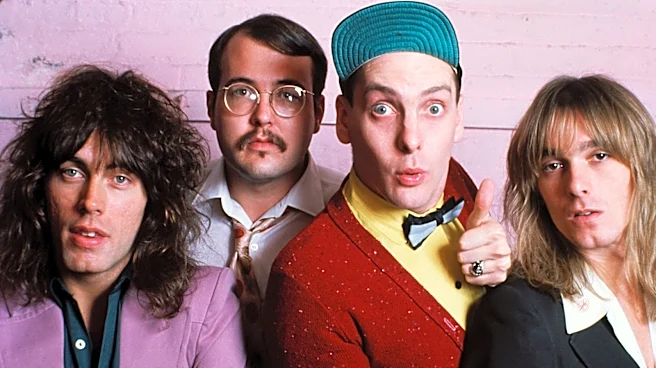
Producer Tom Werman has openly admitted to incorporating the iconic keyboard riff from The Who's song 'Baba O'Riley' into two of Cheap Trick's major power-pop hits: 'Surrender' and 'Dream Police.' Werman, who considers Pete Townshend his main musical
inspiration, explained that he 'just plain stole it' for 'Surrender' from the 1978 album 'Heaven Tonight.' He felt the riff supported Rick Nielsen's signature guitar work. The song 'Surrender' became a significant track for Cheap Trick, gaining considerable airplay and helping to establish the band. Werman later reused a similar, albeit half-time, version of the synthesizer riff for the title track of Cheap Trick's 1979 album, 'Dream Police,' this time utilizing actual string players instead of a synthesizer. This creative decision contributed to the commercial success of both albums, with 'Heaven Tonight' selling hundreds of thousands of copies and 'Dream Police' exceeding a million in sales.
Why It's Important?
This revelation highlights the often-unseen creative processes and influences within the music industry, particularly concerning the borrowing or adaptation of musical motifs. It underscores how a producer's vision and admiration for other artists can directly shape the sound and success of a band. For Cheap Trick, the inclusion of this recognizable riff, even if uncredited at the time, likely contributed to the catchiness and broad appeal of 'Surrender' and 'Dream Police,' helping them achieve mainstream success and arena-rock status. The story also touches upon the evolution of music production, from early electronic sounds created on organs to the use of real orchestral instruments to replicate similar effects. This practice of drawing inspiration from existing works, while common, raises questions about originality and influence in popular music, demonstrating how elements from one iconic song can be recontextualized to create new hits.
What's Next?
While the events described are historical, the acknowledgment by Tom Werman could spark renewed interest in the production techniques of the late 1970s and the interplay between different rock genres. It might also lead to discussions among music enthusiasts and critics about the nature of musical influence versus appropriation. For fans of The Who and Cheap Trick, this insight offers a deeper understanding of the creative lineage connecting these two influential bands. The story could also serve as a case study in music education, illustrating how producers make decisions that impact a song's commercial viability and artistic direction. There are no immediate legal or commercial consequences expected, as Werman's statement is an admission of influence rather than a new claim of infringement, and the songs have been established for decades.
Beyond the Headlines
The narrative extends beyond a simple admission of musical borrowing, delving into the broader cultural impact of iconic riffs and the subjective nature of musical creation. Pete Townshend's 'Baba O'Riley' riff, initially created on a Lowrey Berkshire Deluxe TBO-1 home organ, became a foundational element that transcended its original context. Werman's decision to 'steal' it for Cheap Trick speaks to the power of a compelling musical idea to resonate across different artists and audiences. This practice, while sometimes controversial, is a testament to the interconnectedness of musical history and the way artists build upon the innovations of their predecessors. It also subtly highlights the role of producers as creative forces who can introduce elements that define a band's sound, sometimes more overtly than the band members themselves might. The story implicitly questions the boundaries of inspiration and originality in a creative field where influences are constantly exchanged and reinterpreted.