




What's Happening?
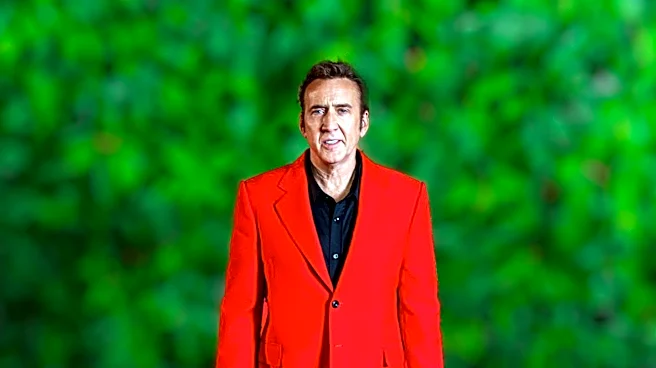
Filmmakers Guillermo del Toro and Quentin Tarantino have publicly expressed their admiration for actor Nicolas Cage, identifying him as one of Hollywood's most underrated talents. Despite Cage's Academy Award win for 'Leaving Las Vegas' and numerous box
office successes, he often faces criticism for his eccentric acting style, which is frequently characterized by exaggerated expressions and unpredictable movements. Del Toro tweeted that there has never been, nor will there ever be, an actor like Nicolas Cage, calling him 'A master.' Tarantino echoed this sentiment, stating he has never seen another actor who made a career of being 'miscast and rising to the occasion.' Both directors appreciate Cage's fearlessness and commitment to his roles, even in less successful projects, viewing these qualities as what make him exceptional and unique.
Why It's Important?
This endorsement from two highly respected and successful directors like Guillermo del Toro and Quentin Tarantino carries significant weight within the film industry. Their public praise challenges the prevailing narrative that often reduces Nicolas Cage's performances to mere 'overacting' or 'extreme theatrics.' For an actor who has frequently been the subject of internet memes and critical ridicule, this validation from his peers can help reframe public perception and encourage a deeper appreciation for his distinctive artistic choices. It highlights a broader discussion within Hollywood about what constitutes 'good' acting and whether unconventional styles are adequately recognized. This could potentially influence future casting decisions, leading to more diverse roles for actors who defy traditional performance norms, and encourage audiences to look beyond surface-level criticisms.
What's Next?
While both directors have praised Cage, neither has yet directed him in a film. Quentin Tarantino considered Cage for three different roles in 'Pulp Fiction,' and Guillermo del Toro discussed casting him in an unconventional adaptation of 'The Count of Monte Cristo,' where Cage would have played a gothic gunslinger with a mechanical arm. Although these collaborations did not materialize, the continued public support from such influential figures could reignite interest in future projects involving Cage. This renewed attention might lead to new opportunities for the actor, potentially with these directors or others who are inspired by their perspective. The ongoing discussion about Cage's unique talent could also encourage film critics and audiences to re-evaluate his extensive body of work with a fresh, more appreciative lens.
Beyond the Headlines
The shared admiration for Nicolas Cage by Guillermo del Toro and Quentin Tarantino delves into the deeper cultural and artistic implications of how talent is perceived and valued in Hollywood. It questions the industry's tendency to favor naturalism and subtlety, often at the expense of more theatrical or unconventional acting styles. Cage's career, as highlighted by these directors, exemplifies a performer who consistently commits fully to his characters, regardless of critical reception. This perspective suggests that true artistry might lie in fearlessness and individuality, rather than adherence to conventional norms. It also underscores the power of peer recognition in shaping an artist's legacy, potentially inspiring other actors to embrace their unique approaches without fear of backlash, and encouraging a more diverse range of performances in mainstream cinema.