







What's Happening?
The United States continues to impose Section 301 duties on goods imported from China, with the Office of the United States Trade Representative (USTR) confirming in October 2026 that the 2018 technology transfer tariffs remain in effect. These tariffs apply
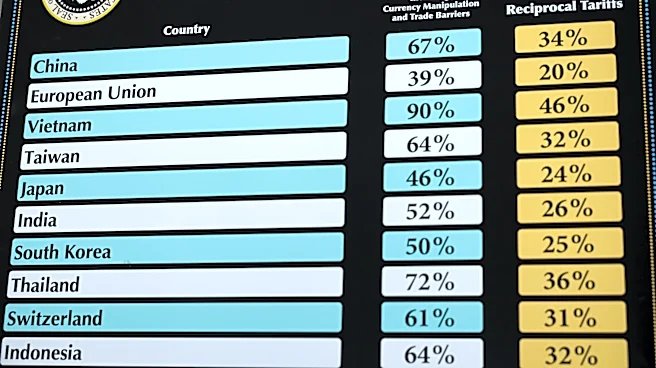
at rates of 7.5% or 25%, with higher rates up to 100% on specific strategic sectors. In addition to these existing duties, a separate 12.5% forced labor duty has been applied to most Chinese goods since July 24, 2026. This new duty is based on a country's enforcement record regarding forced labor imports, rather than specific product details. The Supreme Court struck down tariffs imposed under the International Emergency Economic Powers Act (IEEPA) in February 2026, but Section 301 tariffs were upheld, making them the primary remaining tariff costs on Chinese imports. USTR is also conducting an investigation into structural excess capacity in China, with findings expected by March 11, 2027.
Why It's Important?
The continuation and expansion of Section 301 tariffs, particularly the introduction of a forced labor duty, have significant implications for U.S. importers and global supply chains. These tariffs increase the cost of goods from China, potentially leading to higher prices for U.S. consumers and businesses. The forced labor duty adds a new layer of complexity, requiring companies to assess their supply chain exposure based on country-level enforcement records rather than just product codes. This necessitates a deeper level of due diligence and supply chain mapping for importers. The tariffs also reflect ongoing U.S. policy objectives to address perceived unfair trade practices, intellectual property theft, and human rights concerns related to China. For industries reliant on Chinese imports, these duties can impact sourcing strategies, cost models, and overall competitiveness, potentially accelerating shifts in global manufacturing and sourcing away from China.
What's Next?
U.S. importers must continue to factor Section 301 duties into their cost models, including the rate increases that took effect on January 1, 2026, for certain products like permanent magnets, natural graphite, and rubber medical gloves. Companies need to verify the applicable tariff rates using their products' Harmonized Tariff Schedule of the United States (HTSUS) codes and USTR's search tools. For the forced labor duty, importers must map their supply chains to identify exposure to countries facing such penalties, as this duty is country-specific rather than product-specific. The 178 existing tariff exclusions are set to expire on November 9, 2026, though they may be extended. The ongoing USTR investigation into China's structural excess capacity could lead to further duties or policy changes by March 2027. Businesses are advised to consult with customs brokers to ensure compliance and accurately calculate landed costs.
Beyond the Headlines
The dual application of technology transfer tariffs and forced labor duties on Chinese goods signifies a multifaceted approach by the U.S. to address economic and ethical concerns in its trade relationship with China. This strategy moves beyond traditional trade disputes focused solely on economic imbalances to incorporate human rights considerations directly into tariff policy. The forced labor duty, in particular, represents a growing trend of using trade policy as a tool for promoting ethical sourcing and international labor standards. This could lead to a broader re-evaluation of supply chain ethics across various industries, pushing companies to enhance transparency and accountability in their global operations. The long-term impact may include a restructuring of global supply chains to reduce reliance on regions with human rights concerns, fostering greater diversification and potentially increasing production in countries with stronger labor protections, even if it entails higher costs.