







What's Happening?
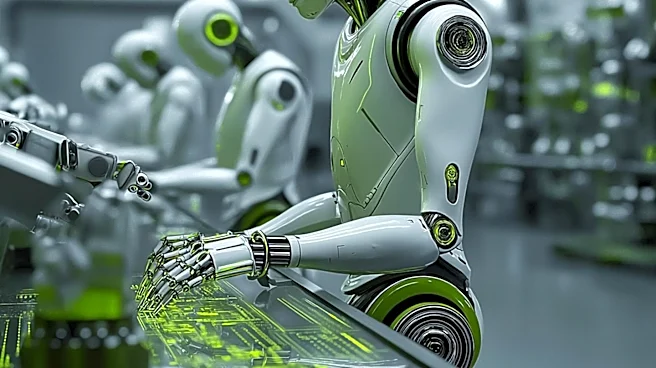
Agility Robotics, a company specializing in humanoid robots, has gone public in the U.S. through a merger with a special-purpose acquisition company, raising approximately $465 million. CEO Peggy Johnson, a veteran of Qualcomm and Microsoft, is now tasked
with making the company's Digit robots profitable. Despite generating only $1.8 million in revenue last year and recording a $138.1 million net loss, Agility Robotics has a head start in the market, with its robots operating in nine customer facilities, including Amazon and Toyota. The company has also secured over $300 million in orders for 1,000 robots from a single customer. However, competition is intensifying with rivals like Figure AI and Apptronik attracting significant investment, and Tesla also entering the humanoid robot space with Optimus.
Why It's Important?
This public listing marks a significant moment for the humanoid robotics industry, as Agility Robotics is the first company in this sector to go public in the U.S. Its success or failure in achieving profitability will likely influence investor confidence and future funding for other humanoid robot developers. The challenge lies in the high production costs of these robots, with the new Digit 5 initially costing $150,000 in materials. Agility's financial model projects cost reductions to $30,000 per robot at higher production volumes and aims for a cost recoupment within 18 months under a robot-as-a-service model. The company is betting on labor shortages in manufacturing and warehousing to drive demand, with a Deloitte study estimating 1.9 million unfilled U.S. manufacturing jobs by 2033.
What's Next?
Agility Robotics' immediate focus is to expand the capabilities of its Digit robots to make them more useful to industrial customers. The company recently opened a 60,000-square-foot engineering facility in Fremont, California, to develop new skills for its robots. Agility has accumulated 65,000 hours of commercial operating data, which will be used to improve its technology with each new deployment. While CEO Peggy Johnson envisions humanoid robots eventually entering homes, she does not expect this to happen within the next five years. The company has 30 qualified prospective customers in its pipeline, indicating potential for future deployments and revenue growth as it works to scale production and reduce costs.
Beyond the Headlines
The public debut of Agility Robotics highlights the broader debate within the robotics industry about the necessity and viability of humanoid forms. While significant investments are pouring into the sector, experts remain divided on whether robots need to resemble humans to be effective. The company's journey to profitability will serve as a crucial case study for the commercialization of advanced robotics, particularly in addressing the unit economics and scalability challenges. The long-term implications extend to the future of labor, as the adoption of humanoid robots in industrial settings could reshape workforce dynamics and potentially alleviate labor shortages in specific sectors, while also raising questions about job displacement and the need for new skill sets.