


What's Happening?
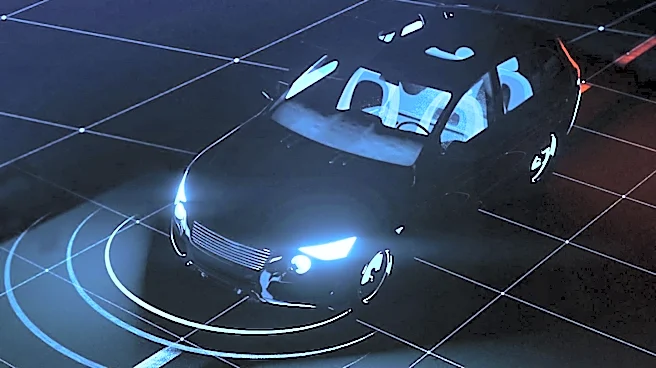
Tesla has begun rolling out its highly anticipated Full Self-Driving (FSD) v15 software. This new version includes 'Tesla Reality View,' an interactive, real-time AI visualization that re-renders the surrounding environment like a video game while utilizing
less computational power. The software incorporates a new vision encoder, shared with Tesla's Robotaxi and Optimus programs, which has been trained on millions of internet videos and reportedly offers a 25x improvement in managing safety-critical interventions. The update also addresses common driving challenges by enhancing detection of potholes, road signs, and standing water, and introduces automatic slowdowns at speed cameras, along with a dedicated Bike Rack Mode. Following this announcement, Tesla's stock saw a 4% increase in premarket trading.
Why It's Important?
The release of Tesla's FSD v15 software is significant for the automotive industry and the broader technology sector. JPMorgan analyst Rajat Gupta highlighted that this update further solidifies Tesla's lead in consumer autonomy, setting a higher benchmark for competitors like Rivian, Ford, and GM, who are also developing their own autonomous driving technologies. The reported 25x improvement in handling safety-critical interventions could enhance public trust and accelerate the adoption of self-driving vehicles. Furthermore, the software's compute efficiency improvements mean that a near-term upgrade to AI5 hardware is not immediately necessary, simplifying the transition for the existing consumer fleet and reducing hardware upgrade complexities for pre-HW4 vehicles. This could translate into cost savings and a smoother user experience, reinforcing Tesla's market position.
What's Next?
The continued rollout of Tesla's FSD v15 software will likely be closely monitored by both consumers and industry analysts. The performance of the new features, particularly the 'Tesla Reality View' and the enhanced safety interventions, will be critical in shaping public perception and regulatory discussions around autonomous driving. Competitors are expected to continue their own development efforts, with Rivian planning to showcase its autonomy roadmap and Ford and GM advancing their respective launches. The long-term impact on Tesla's stock performance will depend on the successful implementation and widespread acceptance of FSD v15, as well as how it influences the broader competitive landscape in the autonomous vehicle market. Further updates and refinements to the software are also anticipated as Tesla continues to gather data and improve its AI models.
Beyond the Headlines
The advancements in Tesla's FSD v15 software, particularly the 'Tesla Reality View' and the improved vision encoder, point towards a future where vehicles are not just transportation devices but sophisticated AI-driven platforms. The ability to re-render the surrounding environment in real-time with less compute could have implications beyond driving, potentially influencing augmented reality applications and other AI-powered systems. The focus on safety-critical interventions and the training on millions of internet videos underscore the increasing reliance on vast datasets and advanced machine learning for critical functions. This development also raises ethical and legal questions regarding the responsibility of AI in driving decisions and the potential for bias in training data. The ongoing evolution of FSD technology will likely necessitate new regulatory frameworks and societal discussions about the integration of highly autonomous systems into daily life.