






What's Happening?
The High Court in London has ruled that international sanctions, while making contractual payments unlawful, do not automatically terminate or 'frustrate' long-term commercial contracts. This decision came in a case involving GTLK Malta Four, a subsidiary
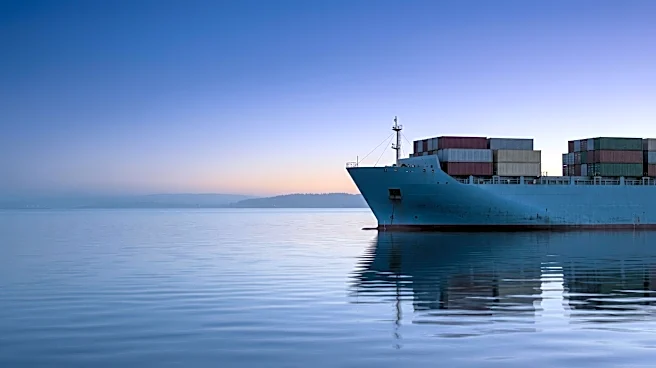
of Russia's state-owned transport leasing company JSC GTLK, and Pola Logistics, a Cyprus-incorporated company that chartered seven vessels. JSC GTLK was sanctioned by the EU, UK, and U.S. in 2022, leading Pola Logistics to cease hire payments and attempt to terminate the charters, citing the illegality of payments due to sanctions. However, the court found that the contracts, particularly a 'hell or highwater clause,' placed the risk of such disruptions on Pola Logistics. The ruling means that the obligation to pay was suspended rather than destroyed, and the guarantors of Pola Logistics' obligations remain liable for approximately $12.9 million, with three facing an additional $29.1 million.
Why It's Important?
This High Court ruling has significant implications for U.S. businesses and international commerce, particularly those operating in sectors susceptible to geopolitical risks and sanctions. It clarifies that sanctions may suspend payment obligations but do not necessarily absolve parties of their underlying contractual liabilities, especially when contracts include clauses allocating risk for unforeseen events. For U.S. companies engaged in global trade, shipping, or finance, this decision underscores the importance of meticulously drafted contracts that anticipate and address the impact of sanctions. It suggests that simply citing sanctions as a reason to terminate a contract may not be sufficient, potentially leading to substantial financial liabilities. The ruling could influence how U.S. courts interpret similar contractual disputes arising from sanctions, reinforcing the principle that contractual obligations, even when temporarily impeded, often endure. This could lead to increased scrutiny of force majeure and similar clauses in international agreements.
What's Next?
The High Court's decision grants summary judgment against the guarantors, meaning they are liable for the unpaid amounts. However, separate London Maritime Arbitrators Association proceedings initiated by Pola Logistics regarding the charters are still ongoing. These arbitration proceedings will likely delve deeper into the specifics of the charter agreements and the impact of sanctions on their performance. The outcome of these arbitrations could further refine the understanding of contractual obligations in the face of sanctions. The ruling may also prompt a review of existing contracts by businesses globally, encouraging them to strengthen clauses related to sanctions, force majeure, and risk allocation. Legal professionals will likely analyze this decision closely to advise clients on mitigating risks associated with international sanctions and ensuring contractual resilience in volatile geopolitical environments.
Beyond the Headlines
This case delves into the fundamental legal principle of 'frustration of contract' versus 'suspension of obligation' in the context of international sanctions. The court's emphasis on the contractual allocation of risk, particularly through clauses like the 'hell or highwater clause,' highlights a shift towards holding parties accountable for risks they contractually agreed to bear, even when external events like sanctions intervene. This has broader implications for the sanctity of contracts in international law and the predictability of commercial relationships. It suggests that parties cannot easily escape contractual commitments by invoking sanctions if their agreements already contemplate such risks. The ruling also underscores the evolving legal landscape surrounding sanctions, where the initial imposition of restrictions may be followed by their easing or modification, further complicating the assessment of contractual performance over time. This dynamic environment necessitates continuous legal and commercial vigilance for businesses operating internationally.