


What's Happening?
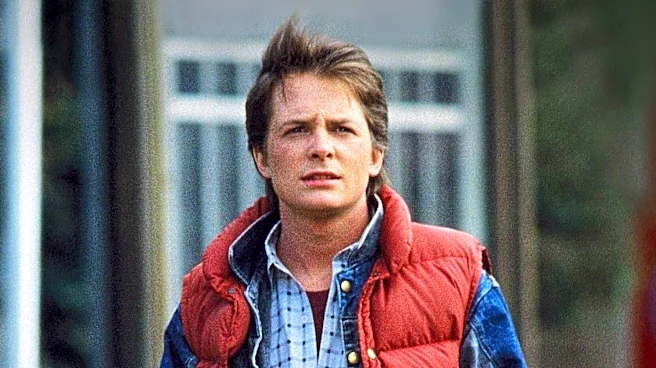
Michael J. Fox starred as Marty McFly in the 1985 film 'Back to the Future,' a science fiction comedy directed by Robert Zemeckis and produced by Steven Spielberg. The movie centers on Marty, a teenager who accidentally travels back to 1955 in a DeLorean
time machine invented by the eccentric Doc Brown (Christopher Lloyd). This unexpected journey leads to a series of events that jeopardize Marty's own existence and future, as he inadvertently interferes with his parents' first meeting. The film is widely recognized for its innovative time-travel narrative, the strong on-screen chemistry between Fox and Lloyd, and its significant cultural impact on the sci-fi genre. The Coolidge Corner Theater has even hosted 'Relaxed Screenings' of the film, indicating its enduring popularity and accessibility for diverse audiences. These screenings feature adjusted environmental settings like increased house lights and lowered volume, alongside open captions, to accommodate patrons who may benefit from a more relaxed viewing experience.
Why It's Important?
The enduring popularity of 'Back to the Future,' largely attributed to Michael J. Fox's portrayal of Marty McFly, highlights the lasting cultural significance of certain cinematic works in the U.S. The film's continued presence in public discourse, nearly four decades after its release, demonstrates its ability to transcend generations and maintain relevance. Its innovative storytelling and memorable characters have influenced countless subsequent films and television shows, solidifying its place as a classic. The film's themes of destiny, consequence, and the impact of individual actions on the future resonate deeply with audiences, offering both entertainment and thought-provoking narratives. Furthermore, the existence of 'Relaxed Screenings' for the film underscores a growing awareness and effort within the entertainment industry to make cinematic experiences more inclusive and accessible to a broader audience, reflecting evolving societal values regarding public accommodations.
What's Next?
The continued celebration and re-screening of 'Back to the Future' suggest that its cultural footprint will persist, potentially introducing new generations to its narrative and themes. Documentaries like 'Back in Time' further explore the film's impact, indicating ongoing academic and fan interest in its legacy. Future events, such as special screenings or anniversary celebrations, are likely to continue, reinforcing the film's status as a beloved piece of American cinema. The film's influence may also be seen in future creative works that draw inspiration from its time-travel concepts or character archetypes. The success of inclusive screening initiatives like 'Relaxed Screenings' could also encourage other theaters and film distributors to adopt similar practices, expanding accessibility for various audiences across the U.S. entertainment landscape.
Beyond the Headlines
Beyond its entertainment value, 'Back to the Future' has sparked broader discussions about the ethics of time travel and the butterfly effect, influencing not only science fiction but also philosophical thought experiments. The film's depiction of 1950s and 1980s American culture offers a nostalgic lens through which audiences can reflect on societal changes and technological advancements. Michael J. Fox's personal journey, particularly his public battle with Parkinson's disease, has also added another layer of depth to his iconic role, inspiring resilience and advocacy. The film's enduring appeal speaks to a universal human fascination with the past and future, and the desire to understand how choices shape destiny. Its cultural impact extends to various forms of media, including memes and fan theories, demonstrating its deep integration into contemporary popular culture.