



What's Happening?
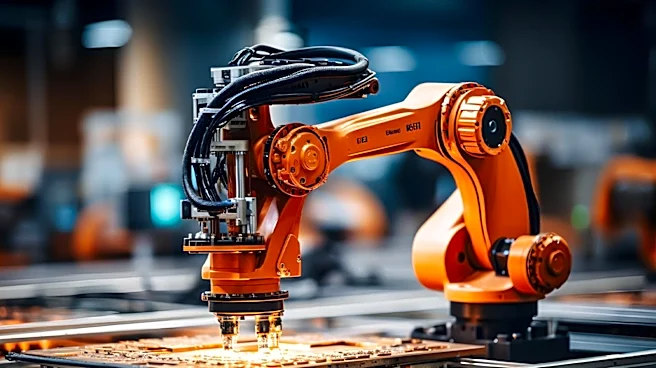
Companies like Eigen Innovations and MVTec are advancing the use of artificial intelligence (AI) in manufacturing to improve quality control, moving beyond traditional inspection methods. Erin Barrett, President and CEO of Eigen Innovations, emphasizes
'predictive quality,' which uses process data and AI to identify developing defects before they are discovered downstream. This approach allows manufacturers to intervene earlier, preventing significant waste. For example, thermal imaging can detect subtle changes in materials during production, providing early warnings of potential defects. Christian Eckstein, Product Manager for the Deep Learning Tool at MVTec, highlights that effective inspection often combines AI with traditional machine vision techniques. A pharmaceutical inspection system at Aspen's Notre-Dame-de-Bondeville facility, for instance, uses deep learning for foreign-particle detection alongside conventional vision checks, achieving high accuracy and reducing false positives.
Why It's Important?
The integration of predictive quality and AI inspection in U.S. manufacturing is crucial for enhancing efficiency, reducing costs, and maintaining product quality. By identifying defects earlier in the production process, companies can minimize scrap, rework, and customer returns, leading to significant financial savings and improved brand reputation. This technology is particularly vital in industries with high-value products or strict quality standards, such as automotive, aerospace, and pharmaceuticals. The ability to connect process conditions with product quality allows manufacturers to optimize their operations, leading to more consistent output and competitive advantages. Furthermore, the hybrid approach of combining AI with traditional machine vision ensures robust and reliable inspection systems, addressing the complexities of diverse manufacturing environments and product variations.
What's Next?
The future will see continued development in AI models that can adapt to changing production conditions and transfer effectively across different factory settings. Manufacturers will focus on establishing clear routes to action for AI-generated signals, determining when human intervention is required versus when automatic responses are justified. Stephen Graham, Vice President Product & Technology for Hexagon’s Production Software division, suggests that AI-assisted CAM programming will play a role in preventing defects even before material cutting begins. The industry will also work on refining the balance between model accuracy and processing speed to ensure AI solutions are practical for industrial cycle times. Ongoing efforts will involve calibrating detection thresholds to minimize false alarms and maximize the value of AI-driven quality control.
Beyond the Headlines
The evolution of AI in manufacturing quality control raises deeper questions about the role of human expertise and decision-making in automated environments. While AI can identify patterns and predict defects, the ultimate responsibility for intervention and process adjustment often remains with experienced production personnel. This creates a need for new training paradigms that equip workers to interpret AI insights and collaborate effectively with intelligent systems. The ethical implications of AI making critical decisions on a production line, especially concerning safety and product reliability, will also become more prominent. Furthermore, the ability to trace a product's entire manufacturing history through AI-linked inspection data could revolutionize product liability and recall processes, offering unprecedented transparency and accountability. This shift represents a move towards 'smart factories' where every stage of production is monitored and optimized by intelligent systems, fundamentally altering industrial operations.