
What's Happening?
The CARICOM Private Sector Organization (CPSO) has been appointed to the inaugural board of directors for the Organization of American States (OAS) 'Private Sector of the Americas' Initiative. This appointment
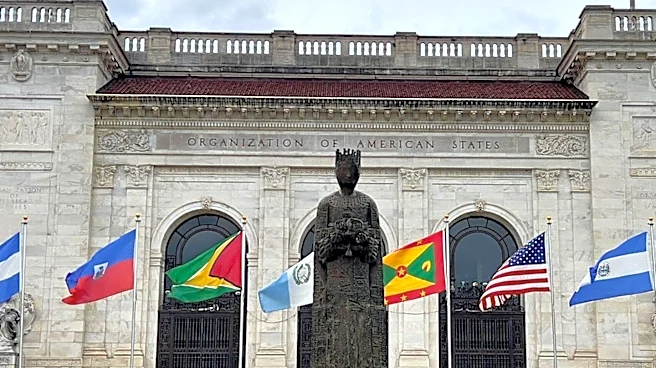
grants the Caribbean private sector a formal platform within the hemisphere's newest business initiative. The board was unveiled on November 11 at the OAS headquarters in Washington, D.C., to an audience of over 250 business leaders, government representatives, and diplomats. Dr. Patrick Antoine, CEO and technical director of the CPSO, will represent the Caribbean, joining board chair Bettina Bulgheroni of Argentina and representatives from other key business organizations, including the Latin American Business Council (CEAL), the Latin American Chamber of Commerce of the United States (CAMACOL), and the Federation of Chambers and Industrial Associations of Central America and the Dominican Republic (FECAICA). The Initiative, launched in Panama City in June by OAS secretary general Albert R. Ramdin, aims to connect chambers of commerce and industry leaders across the Americas with governments and development institutions to foster regional economic growth.
Why It's Important?
This appointment is significant as it provides the Caribbean private sector with a direct voice in shaping hemispheric economic priorities. Dr. Antoine has outlined three key priorities the CPSO will advocate for on the board: connectivity, financing for small and medium enterprises (SMEs), and resilience. He emphasized that the Initiative's success should be measured by tangible outcomes such as 'deals closed, containers moved and jobs created, not meetings held.' The Caribbean region faces several economic pressures, including potential increases in shipping costs due to the International Maritime Organization’s Net-Zero Framework, the impact of United States’ tariffs and maritime measures on CARICOM exporters, and ongoing constraints on correspondent banking and trade finance. These issues are fundamentally 'cost-of-connecting' problems that the 'Private Sector of the Americas' Initiative is designed to address. The CPSO's participation ensures that the region's specific challenges and proposals, such as de-risking intra-regional trade, deepening regional capital markets, and strengthening the CARICOM Single Market and Economy (CSME), will be brought to the forefront of hemispheric discussions.
What's Next?
The CPSO plans to brief its members and national private sector organizations across the Caribbean on the board's work program in the coming weeks. The 'Private Sector of the Americas' Initiative remains open to other organizations and partners throughout the hemisphere who are prepared to contribute proposals, expertise, and tools. The focus will be on translating discussions into sustained action, with OAS secretary general Ramdin inviting participants to help achieve this goal. The Initiative's success will be gauged by its ability to remove investment barriers, strengthen regional trade and value chains, and create opportunities in sectors such as energy and natural resources, digital transformation, infrastructure and logistics, biodiversity, tourism, and food production. The Inter-American Development Bank (IDB) president Ilan Goldfajn highlighted the private sector's crucial role, noting that it creates nine out of ten jobs in Latin America, underscoring the importance of this new platform.
Beyond the Headlines
The inclusion of the CARICOM Private Sector Organization on this hemispheric board signifies a broader recognition of the Caribbean's economic potential and its strategic position as a 'natural bridge' in the Americas. This move could lead to a more integrated and resilient regional economy by fostering greater collaboration between the private sector, governments, and development institutions. The emphasis on 'deals closed, containers moved and jobs created' reflects a shift towards outcome-oriented initiatives, moving beyond mere dialogue to tangible economic development. Furthermore, the Initiative's focus on addressing 'cost-of-connecting' problems, such as shipping costs and trade finance constraints, could have long-term implications for regional supply chains and competitiveness. This platform also provides an opportunity for the Caribbean to assert its sovereignty and economic agency, demonstrating that its nations, though small, are not marginal and are ready to engage in significant business with the wider Americas.