



What's Happening?
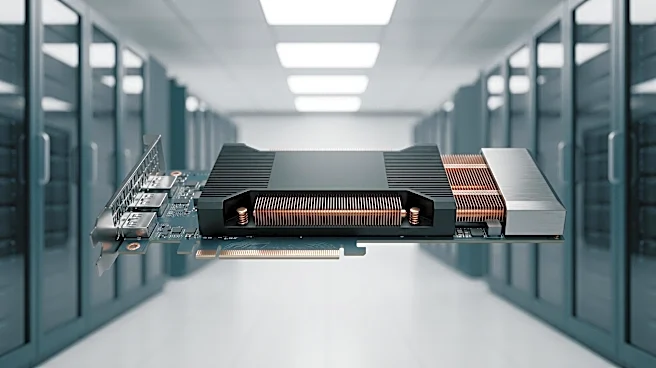
NVIDIA has released the RTX 6000 Ada Generation, a new graphics processing unit (GPU) featuring 48 GB of GDDR6 memory, 18,176 CUDA cores, and a memory bandwidth of 960 GB/s. This GPU is built on the Ada Lovelace architecture and is positioned as the successor
to the RTX A6000, which utilized the Ampere architecture. Despite similar names, the RTX 6000 Ada Generation and RTX A6000 are distinct products with different specifications. Notably, the RTX 6000 Ada Generation does not support NVLink, a feature present in its predecessor that allowed for bridging two cards to pool memory. This new card is designed to handle demanding AI workloads, with its 48 GB memory capacity comfortably fitting 13B-class models at 16-bit precision, 30B-class models at 8-bit, and 70B-class models at 4-bit. It also supports QLoRA fine-tuning for 13B to 30B models and is suitable for image and video generation workflows.
Why It's Important?
The introduction of the NVIDIA RTX 6000 Ada Generation GPU is significant for industries heavily reliant on high-performance computing, particularly in artificial intelligence, machine learning, and content creation. Its enhanced memory bandwidth and increased CUDA cores offer substantial improvements for training larger AI models and executing complex computational tasks more efficiently. The ability to handle 70B-class models at 4-bit precision on a single card expands the scope of what can be achieved in research and development without requiring multi-GPU setups for certain tasks. However, the absence of NVLink support means that users planning to combine multiple GPUs for a unified memory pool, as was possible with the RTX A6000, will need to re-evaluate their hardware strategies. This shift could influence purchasing decisions for businesses and researchers, potentially leading them to consider higher-capacity single cards like the RTX PRO 6000 Blackwell (96 GB) if their memory requirements exceed 48 GB per GPU.
What's Next?
The NVIDIA RTX 6000 Ada Generation is expected to be adopted by professionals and organizations engaged in advanced AI development, scientific simulations, and high-end content creation. Users currently utilizing RTX A6000 cards will need to assess whether the performance gains and architectural differences of the Ada Generation outweigh the loss of NVLink functionality for their specific workflows. Cloud computing platforms, such as Runpod, are already offering access to the RTX 6000 Ada, indicating its immediate availability for broader use. The market will likely see continued innovation in GPU technology, with future generations potentially addressing the demand for even larger memory capacities and improved inter-GPU communication methods to support increasingly complex AI models and computational challenges.
Beyond the Headlines
The evolution of GPUs like the RTX 6000 Ada Generation underscores a broader trend in computing: the increasing demand for specialized hardware capable of handling the immense computational requirements of artificial intelligence. This development highlights the ongoing race among technology companies to provide more powerful and efficient tools for AI development, which in turn drives advancements across various sectors, from healthcare and finance to entertainment and autonomous systems. The architectural changes, such as the removal of NVLink in this specific model, also reflect NVIDIA's strategic decisions regarding product segmentation and the optimization of GPUs for different use cases, potentially pushing developers to adapt their software and model architectures to best leverage the available hardware capabilities. This continuous cycle of hardware innovation and software adaptation is crucial for the sustained growth and application of AI technologies.