


What's Happening?
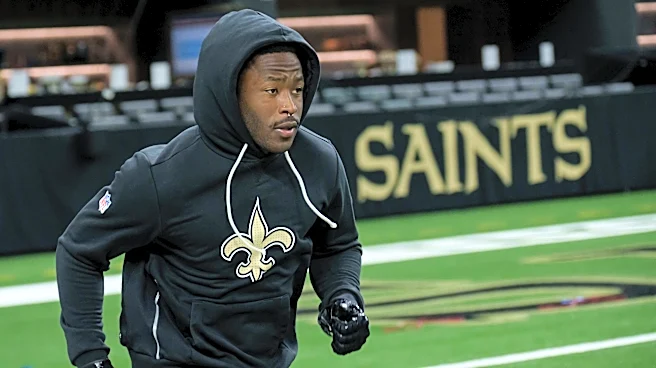
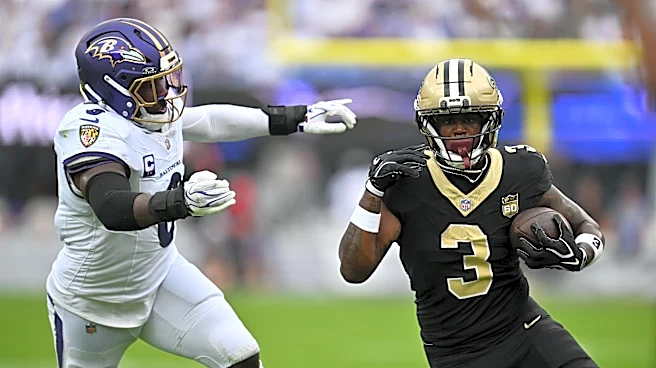
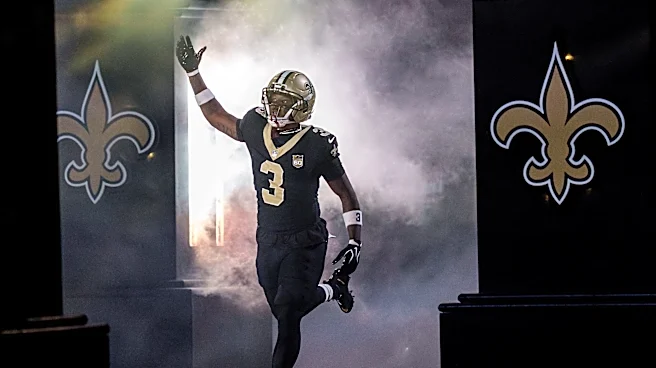
Travis Etienne Jr., running back for the New Orleans Saints, made his return to action in Week 10 against the Panthers after recovering from a hamstring injury that had sidelined him since Week 3. Despite leading the Saints' backfield with 11 touches,
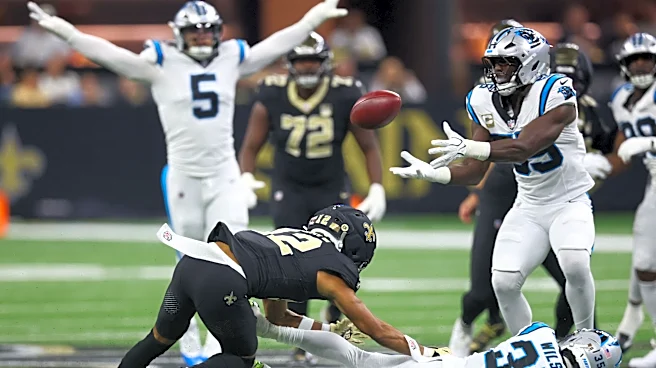
Etienne had a limited impact on the game. He carried the ball eight times for 14 yards and caught three of five targets for 20 yards in the team's 20-17 loss. While Etienne appears to be the top option at running back, his workload was shared with Audric Estime, who had eight touches, and Alvin Kamara, who had five touches and scored two short touchdowns. This performance raises questions about the Saints' strategy for their running back usage, especially considering Etienne's significant contract.
Why It's Important?
The limited impact of Travis Etienne Jr. in his return is significant for the New Orleans Saints, particularly given the substantial contract he received as a presumed No. 1 running back. His performance in Week 10, where he failed to generate significant yardage despite leading in touches, suggests a potential disconnect between his contractual expectations and his on-field role. If Etienne, a highly paid player, is not consistently utilized as a primary offensive weapon, it could impact the team's overall offensive efficiency and their ability to contend for a playoff spot. The Saints' continued use of a committee approach, with Alvin Kamara handling red-zone duties and Audric Estime taking short-yardage work, could cap Etienne's upside and make his large contract less impactful. This situation could lead to financial inefficiencies for the team and affect their strategic planning for future seasons.
What's Next?
Travis Etienne Jr. is expected to seek a larger share of the workload in Week 11 when the Saints face the Bears. The team's coaching staff will likely need to evaluate how to best integrate Etienne into the offense to maximize his potential, especially given his contract. If the current committee approach persists, it could continue to limit Etienne's production and raise further questions about the team's investment in him. For the Saints to make a push towards the playoffs, Etienne will need to consistently get the ball and make plays. The second half of the season will be crucial in determining whether Etienne can establish himself as the true RB1 the Saints paid him to be, or if the team will continue with a shared backfield approach.
Beyond the Headlines
The situation with Travis Etienne Jr. and the New Orleans Saints highlights a broader trend in the NFL regarding the valuation and utilization of running backs. Despite Etienne receiving a contract typically associated with a top-tier running back, his workload and on-field impact have not consistently matched that expectation. This raises questions about the long-term strategy of investing heavily in a single running back, especially when teams opt for a committee approach. The ethical implications for players involve managing expectations and performance under significant financial pressure, while teams must balance player investment with strategic roster construction. This scenario could influence future contract negotiations for running backs across the league, potentially shifting how teams allocate resources to the position if high-value contracts don't consistently translate to dominant individual performances.