




What's Happening?
Robbyant, an embodied AI company within Ant Group, has open-sourced two new AI models, LingBot-Map 2.0 and LingBot-Navi, aimed at significantly improving robotic navigation and spatial memory. These models are designed to tackle critical challenges in autonomous
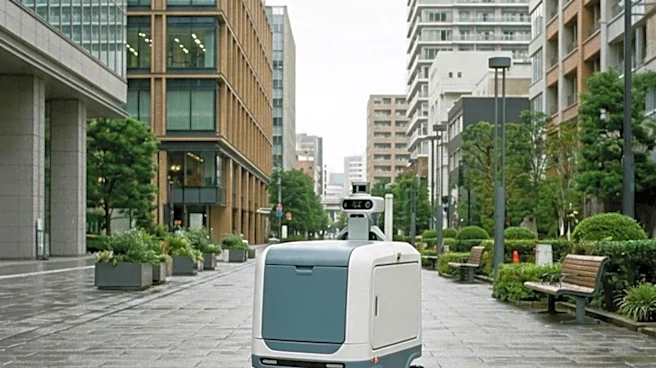
robotics, specifically the accumulation of mapping errors over extended distances and the inability of some navigation systems to retain environmental knowledge between tasks. LingBot-Map 2.0 features a Geometric Context Reshaping (GCR) mechanism, which allows robots to correct internal spatial memory by reusing previously extracted geometric information without re-processing images. This internal correction method updates the robot's representation of its surroundings, offering a more reliable reference for movement. LingBot-Navi, built upon LingBot-Map 2.0, introduces persistent spatial memory, enabling robots to retain information about objects and locations across different missions. This allows robots to retrieve prior spatial data in response to natural language commands, facilitating more efficient route planning. The system also supports on-device operation, which reduces latency and enhances data privacy by keeping user commands and environmental data local.
Why It's Important?
The open-sourcing of Robbyant's AI models holds significant implications for various U.S. industries reliant on physical AI applications, including warehouse logistics, industrial automation, last-mile delivery, and domestic robotics. By addressing mapping errors and improving spatial memory, these models can lead to more reliable and efficient autonomous operations. For businesses, this translates to potential cost savings through reduced operational errors, faster task completion, and optimized resource allocation. The ability of robots to retain spatial memory between missions means less time spent re-learning environments, boosting productivity and adaptability in dynamic settings. Furthermore, the on-device operation feature supports data privacy, a growing concern for companies handling sensitive operational data. The improved accuracy and efficiency offered by these models could accelerate the adoption of robotics in sectors where precision and autonomy are paramount, potentially creating new job opportunities in robot maintenance, programming, and oversight, while also displacing some manual labor roles.
What's Next?
Robbyant has made technical reports, source code, model weights, and a dataset covering 511 real-world captured scenes available through the LingBot-Map 2.0 and LingBot-Navi GitHub repositories. This open-source release is expected to foster further research and development within the robotics and AI communities. Developers, researchers, and companies can now leverage these tools to build upon Robbyant's advancements, potentially leading to new applications and improvements in autonomous systems. The availability of these resources could accelerate the integration of more sophisticated robotic capabilities into commercial and industrial settings. Future developments may focus on refining these models for even greater accuracy and adaptability in more complex and unpredictable environments, as well as exploring their application in new domains. The open-source nature also encourages collaborative innovation, potentially leading to a rapid evolution of robotic navigation and spatial intelligence technologies.
Beyond the Headlines
The development of more sophisticated robotic navigation and spatial memory capabilities, as demonstrated by Robbyant's new models, points to a broader trend in AI: the pursuit of more human-like cognitive functions in machines. The Geometric Context Reshaping (GCR) mechanism, inspired by memory reconsolidation in the human brain, highlights an ongoing effort to mimic biological intelligence to solve complex engineering problems. This approach raises ethical considerations regarding the increasing autonomy of AI systems and their potential impact on human decision-making and control. As robots become more adept at understanding and interacting with their environments, questions about accountability in cases of error or malfunction will become more pressing. The ability of robots to retain and utilize spatial information over time also hints at a future where machines possess a form of 'experience,' influencing their behavior and learning in ways that may become increasingly opaque to human operators. This could lead to a re-evaluation of human-robot collaboration models and the legal frameworks governing autonomous systems.