






What's Happening?
The Lumber Manufactory LLC, a Washington, D.C.-based startup, has launched its inaugural sawmill in New Albany, Mississippi. This facility, which involved an investment exceeding $15 million, aims to tackle America’s 'lumber manufacturing deficit' by
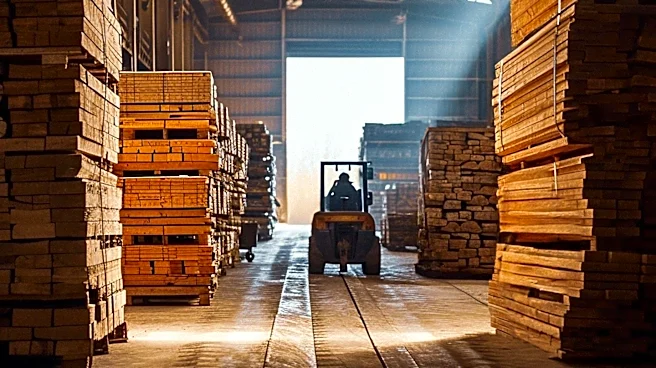
integrating advanced technology and aerospace-derived approaches into the milling process. The sawmill, built and commissioned in approximately 18 months, is now producing Southern Yellow Pine (SYP) dimension lumber with an annual capacity of 45 million board feet (MMBF). The project has generated over 50 jobs, with 35 in production and the remainder in research, engineering, and maintenance. Co-founded in 2023 by CEO Michael Grasso and General Counsel Andrew Arsht, TLM's business model focuses on designing, building, and operating sawmills in areas with high demand for capacity, while tailoring each facility to local timber resources, workforce availability, infrastructure, and end markets. The company's team brings diverse experience from timber and wood products, as well as from advanced industries like Anduril, Blue Origin, SpaceX, and Waymo, influencing its approach to mill construction and operation. This includes combining sawmilling expertise with advanced manufacturing, factory design, automation, software development, and production-system engineering.
Why It's Important?
This initiative is significant for the U.S. lumber industry, which has faced challenges in meeting domestic demand. By introducing a tech-driven approach to sawmilling, The Lumber Manufactory aims to enhance efficiency, speed, and scalability in lumber production. The integration of advanced manufacturing, automation, and AI-driven optimization through its proprietary 'LumberVision' platform could set new industry standards, potentially reducing production times and improving quality control. The company's strategy of building mills in regions with specific needs and resources could also bolster local economies and create jobs in areas requiring industrial growth. Furthermore, the project's focus on Southern Yellow Pine, a widely used timber, directly addresses a critical component of the construction and housing sectors. The bipartisan SAWMILL Act, co-sponsored by U.S. Sen. Cindy Hyde-Smith, which seeks to authorize a USDA loan guarantee program for sawmill construction and expansion, underscores the national recognition of the need for increased domestic lumber manufacturing capacity. This legislative support highlights the broader economic and strategic importance of such ventures for national self-sufficiency in timber resources.
What's Next?
The New Albany sawmill will serve as The Lumber Manufactory’s technology development center, allowing the company to test and refine new hardware, software, and automation in a live production environment before implementing them in future mill designs. This approach is intended to accelerate the design, construction, commissioning, and operation of subsequent facilities. The company plans to announce the location of its next mill in the coming months, indicating a rapid expansion strategy across the U.S. CEO Michael Grasso emphasized the need for 'hundreds of mills' to address the national lumber deficit, suggesting a long-term vision for significant industrial growth. The success of TLM's model could encourage other companies to adopt similar tech-forward strategies, potentially transforming the traditional lumber industry. Continued public policy support, such as the SAWMILL Act, will be crucial for facilitating this expansion and ensuring the availability of necessary financing for new mill projects. The company's ability to adapt its engineering methods and technology systems to diverse regional conditions will be key to its sustained growth and impact on the U.S. lumber market.
Beyond the Headlines
The Lumber Manufactory's entry into the lumber industry represents a broader trend of applying advanced technological and engineering principles from high-tech sectors like aerospace to traditional manufacturing. This cross-industry innovation could lead to a paradigm shift in how resource-intensive industries operate, emphasizing efficiency, data-driven decision-making, and automation. The 'LumberVision' platform, with its real-time visibility and AI-driven optimization, exemplifies the potential for digital transformation to enhance productivity and sustainability in sectors often perceived as slow to innovate. Ethically, this approach could lead to more sustainable forestry practices by optimizing resource utilization and reducing waste, though the environmental impact of increased milling capacity would need careful monitoring. Culturally, the revitalization of domestic manufacturing through high-tech investment could shift perceptions of industrial jobs, attracting a new generation of skilled workers interested in advanced manufacturing and automation. The long-term implications include a potential reduction in reliance on imported lumber, greater price stability in the U.S. housing market, and a strengthened domestic supply chain, contributing to national economic resilience.