






What's Happening?
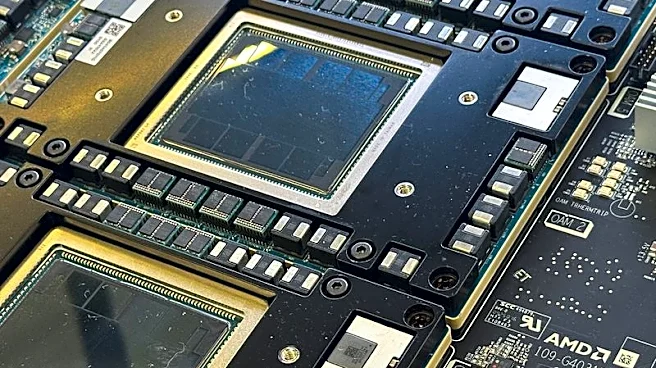
Amid a broader market downturn affecting chip stocks, two companies, Micron Technology (NASDAQ: MU) and Taiwan Semiconductor (NYSE: TSM), are being highlighted as strong investment opportunities. Unlike popular AI chip designers such as Nvidia and AMD,
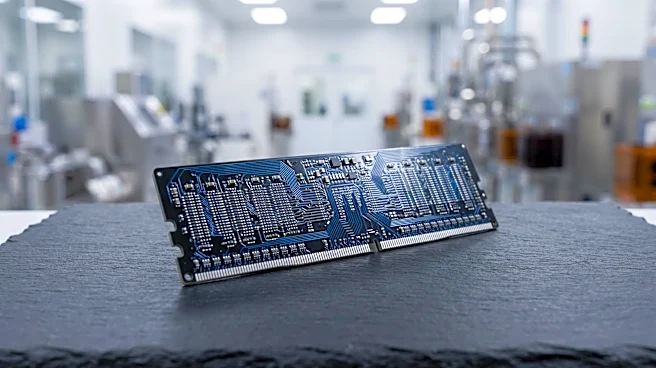
these companies are actual fabricators of the chips. Taiwan Semiconductor manufactures logic chips, holding over 70% of the global chip foundry revenue in Q2, while Micron produces memory chips. Both types of chips are essential for computing units, particularly in the expanding AI sector. The market for memory chips, where Micron operates, is driven by supply and demand, with conditions expected to tighten in 2027 and 2028, suggesting significant upside for Micron. Taiwan Semiconductor, with its dominant market share and track record in chip technology development, offers a more stable investment with potential for substantial returns.
Why It's Important?
The focus on Micron and Taiwan Semiconductor underscores a critical distinction in the semiconductor industry: the difference between chip design and chip fabrication. While companies like Nvidia and AMD design advanced AI chips, their reliance on fabricators like Taiwan Semiconductor and Micron highlights the foundational importance of manufacturing capabilities. This distinction is crucial for the U.S. economy and its technological leadership, as robust domestic or allied fabrication capacity is vital for supply chain resilience and national security. Investing in these fabricators could yield significant returns for U.S. investors, particularly as the AI build-out continues to drive demand for both logic and memory chips. The stability offered by Taiwan Semiconductor and the potential for explosive growth from Micron could balance investment portfolios, contributing to economic growth and technological advancement.
What's Next?
The continued expansion of the AI sector is expected to drive sustained demand for both logic and memory chips, benefiting companies like Taiwan Semiconductor and Micron. Micron's management anticipates tighter supply-demand conditions in 2027 and 2028, suggesting a favorable market environment for memory chip producers. Taiwan Semiconductor is likely to maintain its dominant position due to its extensive production capacity and ongoing advancements in chip technology. Investors will be closely watching the market's valuation of these companies, particularly Micron, which is seen as having significant upside potential if it returns to its normal valuation. The performance of these foundational chip manufacturers will be a key indicator of the broader health and growth trajectory of the AI industry and the technology sector as a whole.
Beyond the Headlines
The emphasis on chip fabricators like Micron and Taiwan Semiconductor reveals a deeper strategic imperative beyond immediate stock market gains: the global competition for semiconductor manufacturing dominance. The U.S. has been actively pursuing initiatives to bolster domestic chip production, recognizing its critical role in economic competitiveness and national security. The reliance of U.S. tech giants on overseas fabricators, particularly Taiwan Semiconductor, highlights vulnerabilities in the supply chain. Investments in these companies, whether direct or indirect, contribute to the broader ecosystem that supports technological innovation. The 'commodity-like' nature of memory chips, as described for Micron, also points to the cyclicality and intense competition within certain segments of the semiconductor market, where pricing power is limited and profitability is heavily influenced by supply-demand dynamics.