






What's Happening?
John Deere has launched a new AI assistant named 'JD', integrated into its Operations Center. This AI tool is designed to provide farmers with immediate, data-driven answers to optimize various aspects of their agricultural operations. The assistant aims
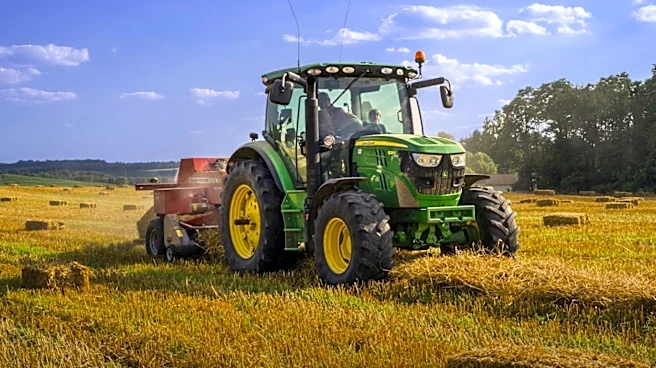
to help farmers improve crop yields, achieve fuel savings, and accurately pinpoint optimal harvest times. This initiative is part of John Deere’s broader Farmer Data Commitment, which emphasizes farmer control over their data. The company assures that farmer data will not be sold and that farmers have the option to disable third-party access to their data at any time. An early access program for eligible U.S. participants is currently available, with plans for wider availability later this year. In addition to this technological advancement, John Deere continues to offer a range of agricultural machinery, including various tractor models for sale, such as the 2440 model and the 2025 John Deere 6R 175 row-crop tractor.
Why It's Important?
The introduction of John Deere's AI assistant, 'JD', marks a significant advancement in agricultural technology, with substantial implications for U.S. farming. By providing immediate, data-driven insights, the AI can help farmers make more informed decisions, potentially leading to increased efficiency and profitability. Improved yields mean greater food production, which can positively impact national food security and reduce reliance on imports. Fuel savings contribute to lower operational costs for farmers, enhancing their economic stability and potentially leading to more competitive pricing for agricultural products. The ability to pinpoint optimal harvest times can minimize crop loss and maximize quality, further boosting farmer income. Furthermore, John Deere's Farmer Data Commitment addresses growing concerns about data privacy and ownership in the agricultural sector, fostering trust between technology providers and farmers. This commitment ensures that farmers retain control over their valuable operational data, which is crucial for maintaining their competitive edge and protecting proprietary farming practices. This move could set a new standard for data governance in agricultural technology, influencing other companies in the sector to adopt similar farmer-centric data policies.
What's Next?
Following the early access program for eligible U.S. participants, John Deere plans to make the 'JD' AI assistant more broadly available later this year. This wider rollout will likely expand the reach and impact of the AI tool across the U.S. agricultural landscape. Farmers who adopt the technology can expect to see continued improvements in their operational efficiency and decision-making capabilities. The success of 'JD' could also spur further innovation in agricultural AI, potentially leading to the development of more sophisticated tools and applications by John Deere and its competitors. Stakeholders, including agricultural technology companies, farming associations, and policymakers, will likely monitor the adoption rates and reported benefits of 'JD'. The emphasis on data control within John Deere's Farmer Data Commitment may also influence future regulatory discussions around data privacy and ownership in agriculture, potentially leading to new industry standards or legislative actions to protect farmer data rights. The ongoing availability of various John Deere tractor models, alongside the new AI assistant, indicates a continued focus on integrating advanced technology with traditional farming equipment.
Beyond the Headlines
The integration of AI like 'JD' into farming operations represents a deeper shift towards precision agriculture, transforming traditional farming into a data-driven enterprise. This evolution raises ethical considerations regarding the role of technology in decision-making, potentially reducing reliance on generational knowledge and intuition. While the AI promises efficiency, it also introduces a new layer of technological dependency for farmers, which could create barriers for those without access to advanced digital infrastructure or technical literacy. The Farmer Data Commitment, while commendable, highlights the increasing value of agricultural data and the ongoing debate about who truly owns and benefits from it. This could lead to broader discussions about data sovereignty in other industries and the need for robust frameworks to protect individual and business data rights. The long-term shift could see farming becoming more automated and optimized, potentially altering the labor landscape in rural areas and requiring new skill sets for agricultural workers. This technological advancement also underscores the growing intersection of agriculture, big data, and artificial intelligence, positioning farming at the forefront of technological innovation.