
What's Happening?
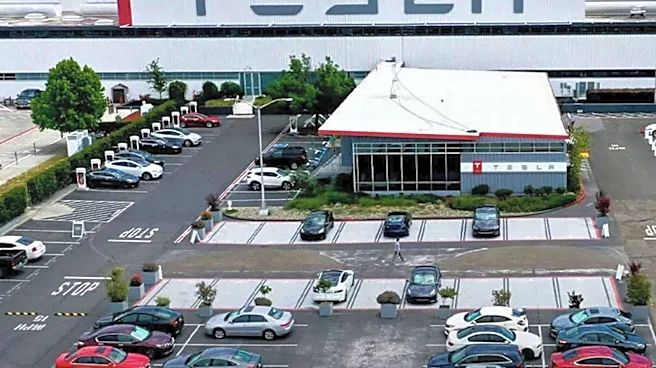
Tesla is planning to construct a $10.1 billion solar cell factory, named 'Project Crystal Sun,' in Fort Bend County, Texas, near Houston. The company's tax-incentive application details that approximately
$1.5 billion will be allocated for land and buildings, with the remaining $8.6 billion designated for equipment. The facility, spanning roughly 3,050 acres near Richmond, aims to commence commercial production in the first quarter of 2029 and is projected to create 9,712 permanent jobs. This significant investment comes as Tesla faces overwhelming demand for its Megapacks, large battery units primarily used by utilities and large businesses, with the company reportedly 'almost sold out of all Megapacks for 2027.' Chief financial officer Vaibhav Taneja noted 'extreme demand from data centers,' which require rapid power solutions, often met by solar panels paired with battery banks. Texas officials still need to approve the incentives for this project.
Why It's Important?
Tesla's 'Project Crystal Sun' represents a substantial commitment to expanding its energy business, which is currently its most profitable segment. The energy gross margin for Tesla rose to 33.1% in the third quarter, up from 20.4% the previous quarter. By integrating solar cell production, Tesla aims to offer a complete power package to data centers and other large consumers, reducing reliance on external suppliers and potentially increasing profit margins. This move is critical for addressing the growing energy demands of data centers, particularly those supporting artificial intelligence, which require power faster than traditional utilities can provide. The factory's projected job creation and economic investment in Texas underscore the broader impact of renewable energy manufacturing on regional economies. The success of this project could solidify Tesla's position as a comprehensive energy solutions provider, influencing the future landscape of energy infrastructure in the U.S.
What's Next?
The immediate next step for 'Project Crystal Sun' involves securing approval for tax incentives from Texas officials, including the Comptroller and the governor's office. Fort Bend County commissioners have already approved four incentive agreements. Tesla is also considering other U.S. locations and intends to finalize a site selection before the end of 2026. Following state approval, the financial performance of Tesla's energy division, particularly its energy gross margin in the fourth-quarter earnings report, will be a key indicator of the project's viability. If margins remain strong after one-time tariff refunds are excluded, it would suggest that the factory supports a self-sustaining business. Conversely, a decline in margins could signal financial strain on Tesla's budget, which is already stretched by other ambitious projects like robotaxis, Optimus robots, and a chip fabrication plant. The project's progress will be closely watched by investors and the energy sector.
Beyond the Headlines
Elon Musk's assertion that solar power will 'ultimately round up to 100% of all energy' highlights a long-term vision that 'Project Crystal Sun' aims to facilitate. This factory is not just about manufacturing solar cells; it's a strategic move to vertically integrate Tesla's energy ecosystem, from generation to storage. The project's success could accelerate the decentralization of energy grids and promote greater energy independence for large-scale consumers. However, the significant capital expenditure required for 'Project Crystal Sun' and other Tesla ventures poses a financial risk, especially given the company's fluctuating free cash flow. The project also raises questions about the scalability of renewable energy solutions to meet the exponential growth of energy-intensive technologies like AI. The outcome of this endeavor will offer insights into the challenges and opportunities of transitioning to a fully renewable energy economy.