







What's Happening?
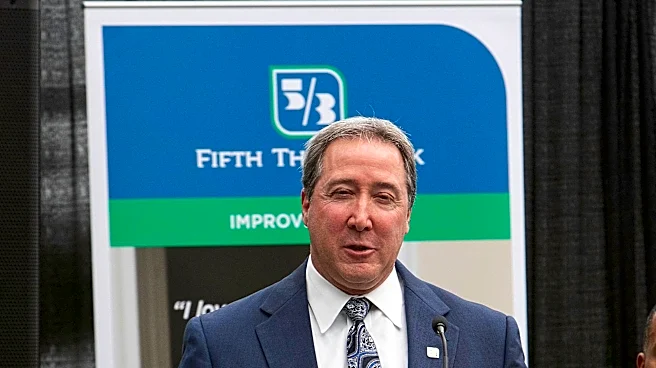
Fifth Third Bancorp is focusing on expanding its presence in Texas and enhancing its commercial banking relationships following the integration of Comerica. Executives at an investor event highlighted that the Comerica acquisition has opened new market
opportunities, particularly in Texas, which Chief Financial Officer Bryan Preston expects to become the bank's third-largest middle-market banking market and potentially surpass Michigan within a year. The bank plans to leverage investments in deposit gathering, new branches, and middle-market banking to build upon Comerica's existing franchise. Additionally, Fifth Third is significantly investing in artificial intelligence (AI) to boost employee productivity and improve customer services. Chief Information Officer Jude Schramm noted that approximately 13,000 to 14,000 employees use Microsoft Copilot daily, and AI tools generate about 40% of the bank's code and perform 90% of its testing, leading to productivity gains of 20% to 30% in engineering. The bank also plans to upgrade its consumer chatbot, Jeanie, to agentic AI to handle customer tasks like payments and money transfers, with deployment pace influenced by governance and customer protection considerations.
Why It's Important?
Fifth Third Bancorp's strategic focus on Texas represents a significant move to capture growth in a dynamic economic region, potentially shifting its market leadership within its operational footprint. This expansion could intensify competition among regional banks in Texas, influencing banking services and offerings for businesses and consumers in the state. The substantial investment in AI is crucial for the banking sector, as it aims to drive operational efficiencies, reduce costs, and enhance customer experience. The reported productivity gains in engineering through AI could set a precedent for other financial institutions, pushing them to accelerate their own AI adoption. Furthermore, the bank's cautious approach to AI deployment, emphasizing governance and customer protections, reflects a broader industry concern about the ethical and security implications of advanced AI, potentially shaping future regulatory discussions and best practices in financial technology.
What's Next?
Fifth Third Bancorp plans to continue its expansion efforts in Texas, with further deposit marketing campaigns under both the Comerica and Fifth Third brands. The bank anticipates that Texas could become its largest middle-market banking market within approximately 12 months, indicating ongoing investment in branches and commercial banking infrastructure in the state. Regarding AI, the bank will proceed with the transition of its consumer chatbot, Jeanie, to agentic AI, starting this quarter and extending into the first half of next year. The pace of this rollout will depend on the bank's comfort with the technology and customer adoption rates. Fifth Third also intends to maintain a disciplined approach to future acquisitions, viewing them as accelerators to its strategy rather than a strategy in themselves, ensuring any potential deals align with financial sense for shareholders and company objectives. The bank will also continue to allocate a significant portion of its technology spending, 45% to 50%, to advancing capabilities and around 15% to cybersecurity.
Beyond the Headlines
Fifth Third Bancorp's dual strategy of geographic expansion and aggressive AI integration highlights a broader trend in the financial services industry: the pursuit of growth through both traditional market penetration and technological innovation. The bank's success in Texas could serve as a case study for other regional banks looking to expand into high-growth markets, potentially leading to increased M&A activity or organic expansion efforts across the U.S. The extensive use of AI, particularly in code generation and testing, points to a future where banking operations are heavily automated, raising questions about workforce transformation and the demand for new skill sets within the industry. The bank's emphasis on cybersecurity, including its development of a code-scanning tool that reduced patching cycles for zero-day vulnerabilities from 30 days to one, underscores the critical importance of robust security measures in an increasingly digital and AI-driven financial landscape, potentially influencing industry standards for cybersecurity resilience.