




What's Happening?
China's Semiconductor Manufacturing International Corp (SMIC) anticipates that the supply chain for artificial intelligence (AI)-related semiconductors will remain constrained until at least 2027. According to SMIC Co-CEO Zhao Haijun, the AI industry
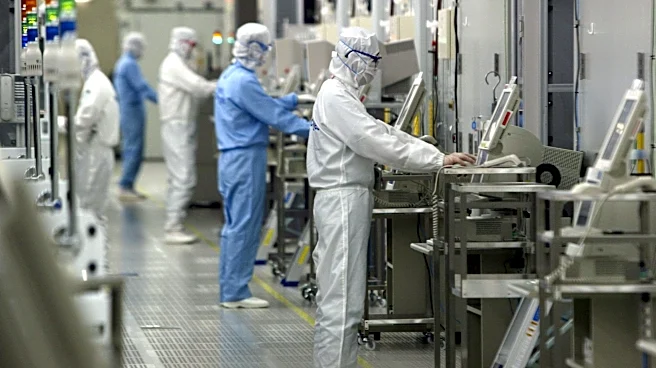
is still in its nascent stages, and demand for computing resources continues to outstrip available supply. This tightness is primarily driven by the increasing needs of data centers and private cloud operators, which require substantial computing power for training AI models, running applications, and supporting enterprise workloads. The constraints extend beyond just processors, with memory chip supply and demand not expected to balance until mid-to-late 2028. Additionally, the manufacturing equipment required to expand chip production faces long delivery timelines, with some orders taking over 24 months, further exacerbating the supply bottleneck.
Why It's Important?
The projected prolonged tightness in the AI chip supply chain has significant implications for the U.S. technology industry and its global competitiveness. U.S. companies heavily rely on advanced semiconductors for their AI initiatives, from developing cutting-edge AI models to deploying AI-powered services. A sustained shortage could slow down innovation, increase operational costs, and potentially delay the rollout of new AI technologies across various sectors. Data centers, crucial infrastructure for cloud providers and enterprises in the U.S., will continue to face challenges in securing the necessary hardware, impacting their ability to scale and meet growing demand. This situation could also intensify the global competition for chip manufacturing capacity and equipment, potentially leading to strategic shifts in supply chain management and increased domestic investment in semiconductor production to mitigate future risks.
What's Next?
In response to the anticipated prolonged chip shortage, U.S. technology companies and policymakers may need to adjust their strategies. Businesses are likely to face longer procurement timelines for AI hardware, necessitating more proactive planning and potentially leading to higher costs. This could accelerate investments in alternative AI hardware solutions or more efficient software optimizations to reduce reliance on scarce components. From a policy perspective, the U.S. government might further incentivize domestic semiconductor manufacturing and research to bolster supply chain resilience. International collaborations and agreements could also become more critical in ensuring a stable supply of essential components. The ongoing demand for AI infrastructure suggests that the 'AI race' will continue, but with a heightened focus on overcoming hardware limitations.
Beyond the Headlines
The persistent AI chip shortage highlights a deeper challenge in the rapid advancement of artificial intelligence: the physical limitations of hardware production. While AI software and algorithms are evolving at an unprecedented pace, the underlying infrastructure required to power them is struggling to keep up. This disparity could lead to a re-evaluation of AI development strategies, emphasizing efficiency and resource optimization rather than solely focusing on computational power. It also underscores the geopolitical significance of semiconductor manufacturing, as control over advanced chip production becomes a critical factor in national technological and economic leadership. The situation may also spur innovation in materials science and manufacturing processes, as companies seek novel ways to produce more powerful and efficient chips with fewer resources and shorter lead times.