
What's Happening?
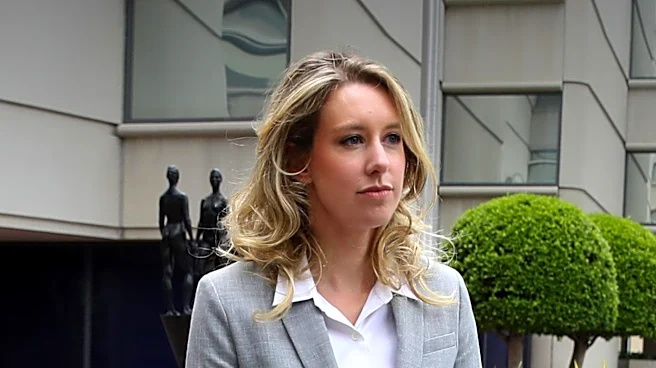
Nathan Fielder's documentary drama, 'You Can See Everything,' which grants him unlimited access to disgraced Theranos CEO Elizabeth Holmes, has achieved significant box office success, surpassing $100
million. The film, co-directed by Lance Oppenheim, premiered over a month ago in the US and a week ago in the UK, quickly becoming a subject of intense public discussion and dissection. Critics and audiences have engaged in extensive analysis regarding Holmes's truthfulness, potential manipulation, and Fielder's role as a filmmaker. The documentary is noted for its unconventional nature, lacking a clear synopsis or didactic takeaway, and was produced with an initial lack of guarantee that a film would even be made from the footage. This success is particularly notable given the film's departure from typical commercial productions, which often rely on established intellectual property or predictable narratives.
Why It's Important?
The commercial success of 'You Can See Everything' is significant because it demonstrates that risk-taking, openness, and unconventional storytelling can resonate with mainstream audiences and achieve substantial financial returns. In an industry often characterized by risk-averse strategies, such as reliance on sequels, adaptations, and established franchises, this film's performance challenges the notion that only predictable content guarantees profit. It suggests a potential shift in audience appetite towards more experimental and thought-provoking cinematic experiences. This success could encourage film and television industries to commission projects that deviate from traditional formulas, fostering greater creative diversity and innovation. For creators, it validates the pursuit of unique artistic visions, even those that are difficult to categorize or explain, offering hope for the future of risk-taking creatives in mainstream media.
What's Next?
The success of 'You Can See Everything' may influence future commissioning decisions within the film and television industry. Studios and production companies might become more open to funding projects that are less conventional, harder to define, and carry inherent creative risks. This could lead to a broader range of content being produced, moving away from the current trend of ambient TV, true-crime adaptations, and recycled intellectual property. For Nathan Fielder, this success further solidifies his reputation as an auteur capable of creating critically acclaimed and commercially viable work that pushes boundaries. Other filmmakers might be inspired to pursue similar experimental approaches, potentially leading to a new wave of innovative documentary and drama that prioritizes unique experiences over predictable narratives.
Beyond the Headlines
The deeper implication of 'You Can See Everything's' success lies in its commentary on contemporary media consumption and the ethics of nonfiction storytelling. Fielder's work, including this film, often explores the dishonesty inherent in nonfiction, examining the roles of makers, subjects, and audiences. The film's reception, characterized by intense dissection and a desire for definitive answers, reflects a digital culture that constantly seeks certainty, often at the expense of experiencing art as intended. This phenomenon highlights a tension between the desire for immediate understanding and the value of ambiguity and surprise in artistic expression. The film's success, despite its resistance to easy categorization, suggests a potential yearning among audiences for experiences that challenge their expectations and engage them on a more profound, less predictable level, pushing against the prevailing culture of instant gratification and definitive explanations.