


What's Happening?
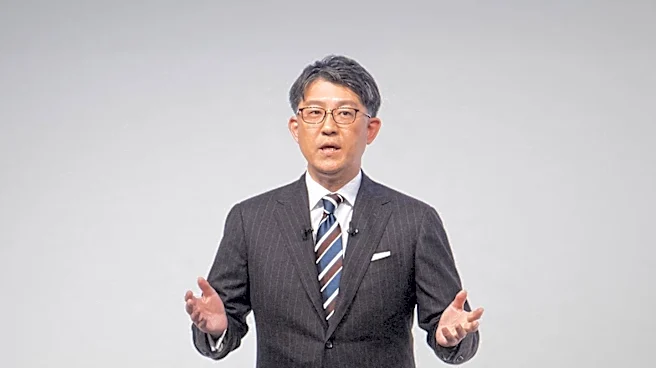
Toyota Motor North America (TMNA) has announced a significant leadership transition set to take effect on January 1, 2027. Concurrently, the company is advancing its software-defined vehicle strategy with the introduction of the 2027 Toyota Sequoia and
Tundra. These new models will integrate Arene, Woven by Toyota's software platform, which debuted in the 2026 Toyota RAV4 and will also be featured in the 2027 Lexus ES. The expansion of Arene to the Sequoia and Tundra marks a crucial step in Toyota's shift towards vehicles that can continuously improve through software updates post-delivery. This platform facilitates cross-domain software-in-the-loop testing, allowing engineers to validate software more thoroughly and earlier in the development cycle. For instance, Arene was utilized in developing the multimedia system's voice agent, center display, and advanced driver assistance features for the Sequoia and Tundra, including the new Trailer Backup Guide system.
Why It's Important?
This strategic move by Toyota Motor North America signifies a major commitment to the future of automotive technology, emphasizing software as a core component of vehicle development and functionality. The transition to software-defined vehicles means that Toyota and Lexus models will offer enhanced capabilities and adaptability, potentially extending their lifespan and improving user experience through over-the-air updates. This approach could set new industry standards for vehicle evolution and customer satisfaction. The advanced testing capabilities provided by Arene, such as simulating hardware environments for software validation, are expected to accelerate development cycles and improve the reliability of new features like the Trailer Backup Guide. This shift also positions Toyota to better compete in a rapidly evolving automotive landscape where software innovation is becoming as critical as hardware engineering, impacting consumer expectations for vehicle intelligence and connectivity.
What's Next?
Toyota plans to significantly expand the deployment of its Arene software platform, aiming to integrate it into approximately 50 models and 10 million vehicles worldwide by 2030. This widespread adoption will further solidify Toyota's transition towards fully software-defined vehicles. The company's continued investment in this technology suggests a future where vehicles are not static products but evolving platforms capable of receiving continuous improvements and new features throughout their operational life. The 2027 Toyota Sequoia and Tundra, along with the 2027 Lexus ES, will serve as key examples of this strategy in the North American market. This ongoing development is expected to lead to more sophisticated driver assistance systems, improved in-car entertainment, and enhanced overall vehicle performance, aligning with Toyota's long-term goal of achieving zero traffic accidents.
Beyond the Headlines
The broader implications of Toyota's software-defined vehicle strategy extend beyond mere technological upgrades; they represent a fundamental shift in the automotive industry's business model and consumer relationship. By enabling continuous software improvements, Toyota is moving towards a service-oriented approach, where the value of a vehicle can increase over time through updates, rather than depreciating immediately after purchase. This could foster greater customer loyalty and open new revenue streams through subscription-based features or enhanced services. Furthermore, the extensive use of simulation and software-in-the-loop testing raises ethical considerations regarding the validation and safety of increasingly complex autonomous and semi-autonomous driving systems. Ensuring the robustness and reliability of software that controls critical vehicle functions will be paramount, as will transparency with consumers about the capabilities and limitations of these evolving technologies.