







What's Happening?
Sam Hargrave's 'Matchbox: The Movie,' an adaptation of the popular Mattel toy line, has premiered to mixed critical reception. While the film is lauded for its exceptional practical action sequences, particularly a stunt involving a truck driven off a 200-foot
bridge, its narrative and character development have been widely criticized. The plot, which follows CIA agent Sean Walker (John Cena) as he is hunted after allegedly stealing a warhead, is described as making little narrative sense and serving primarily as a vehicle for set pieces. The film's opening sequence, set in 1998 Cartersville, Ohio, has been noted for its strong resemblance to Steven Spielberg's early works, featuring a kid gang on bikes and suburban settings. Despite the impressive action, the chemistry among the cast, including John Cena and Jessica Biel, has been described as lacking, with actors appearing disengaged.
Why It's Important?
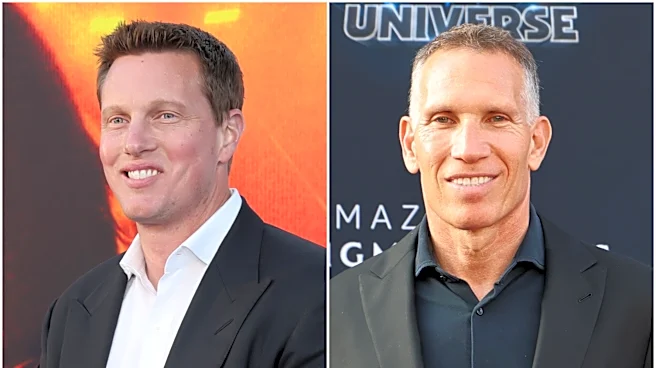
The reception of 'Matchbox: The Movie' highlights a growing concern within the Hollywood industry regarding intellectual property adaptations and the balance between spectacle and storytelling. As the first official film released post-Skydance's takeover of Hollywood, its critical performance could set a precedent for future productions from the conglomerate. The film's reliance on impressive action sequences at the expense of a coherent plot raises questions about the sustainability of this model for major blockbusters. While Sam Hargrave's talent for action choreography is undeniable, the movie's overall shortcomings suggest that even top-tier stunt work cannot fully compensate for a weak script and uninspired performances. This could influence future investment decisions in IP-driven films, pushing studios to prioritize stronger narrative foundations alongside visual effects and action.
What's Next?
Following its release, 'Matchbox: The Movie' will face the test of audience reception and box office performance. Its critical reception, particularly the praise for action and criticism for narrative, will likely be a key talking point in industry analyses. For Skydance, the film's performance will be a crucial indicator of its strategy for adapting popular IPs and its approach to filmmaking in the new era of its expanded influence. Future projects from the company may be influenced by the lessons learned from 'Matchbox,' potentially leading to a re-evaluation of how much emphasis is placed on story development versus action spectacle. For Sam Hargrave, despite the film's overall mixed reviews, his reputation as an action director remains strong, suggesting continued demand for his expertise in choreographing high-octane sequences.
Beyond the Headlines
The critical response to 'Matchbox: The Movie' delves into a broader discussion about the creative health of Hollywood, particularly concerning adaptations of non-narrative intellectual properties like toy lines. The film's perceived algorithmic approach to storytelling, where plot serves merely to connect action sequences, reflects a potential trend towards content generation over genuine artistic creation. This raises ethical questions about the purpose of filmmaking: is it primarily to entertain through spectacle, or to engage audiences with compelling stories and characters? The comparison to Steven Spielberg's early work also highlights a generational shift in filmmaking, where contemporary directors might draw inspiration from past masters but struggle to replicate their narrative depth. This could lead to a re-evaluation of what constitutes a successful film in an era dominated by franchises and IP exploitation, and whether audiences will continue to accept films that prioritize visual thrills over substantive content.