







What's Happening?
OpenAI has reorganized its standalone robotics research team, integrating researchers under Chief Research Officer Mark Chen and hardware engineers under President Greg Brockman. This move, reported by Fortune, aims to align robotics work more closely
with the company's broader research and product development. Despite earlier reports suggesting the team was disbanded, OpenAI clarifies it was a reorganization to enhance collaboration. Concurrently, OpenAI's GPT-6 Astra model has demonstrated significant capabilities in simulations. An Nvidia study showed Astra achieving a 74.8% accuracy rate in the RoboLab-120 simulation benchmark, outperforming previous specialist robot policies by 23.8 points. However, the same study highlighted a critical challenge: each Astra call takes between 11 to 19 seconds, a substantial latency compared to other models that respond in milliseconds. This indicates that while Astra excels in planning, it still requires a fast, specialized controller for real-time robotic actions.
Why It's Important?
This development is significant for the U.S. artificial intelligence and robotics industries. OpenAI's continued investment and reorganization in robotics, despite previous shifts, underscore the strategic importance of embodied AI. The strong simulation performance of GPT-6 Astra suggests a leap in AI's ability to understand and plan complex tasks, potentially accelerating the development of more capable robots. However, the high latency of Astra's decision-making process presents a practical hurdle for real-world applications, particularly in scenarios requiring immediate reactions or high-speed operations. This gap between simulated success and practical deployment highlights a critical area for innovation in AI-driven robotics. Companies and researchers will need to address this latency to transition advanced AI models from theoretical prowess to functional, efficient robotic systems, impacting manufacturing, logistics, and service industries that rely on robotic automation.
What's Next?
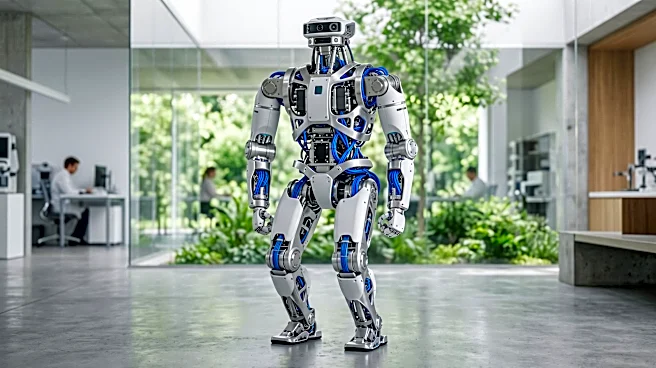
OpenAI CEO Sam Altman is reportedly targeting a public humanoid robot demonstration in 2027, indicating the company's long-term commitment to this field. The current challenge of high latency for GPT-6 Astra suggests that future efforts will likely focus on developing faster, more efficient controllers that can work in conjunction with powerful general models. The industry will be watching for advancements that bridge the gap between AI's planning capabilities and real-time physical execution. Furthermore, the cost associated with Astra's operations, estimated at up to $36.40 per episode in some modes, points to a need for cost optimization to make these technologies commercially viable. The ongoing debate among experts about whether general models will make specialized robotics companies obsolete will continue, with the practical implementation of AI in robotics likely to involve a hybrid approach combining general intelligence with specialized, fast-acting components.
Beyond the Headlines
The reorganization of OpenAI's robotics team and the performance of GPT-6 Astra touch upon deeper implications regarding the future of work and human-robot interaction. The development of highly capable AI models for robotics raises questions about job displacement in sectors amenable to automation and the ethical considerations of deploying increasingly autonomous machines. The latency issue, while technical, also highlights the fundamental difference between human-like deliberation and the instantaneous reactions often required in physical environments. This could lead to new safety standards and regulatory frameworks, such as those being developed by ISO and the EU, to ensure that AI-driven robots operate safely and predictably. The integration of AI into robotics is not just a technological advancement but a societal shift that will necessitate careful consideration of its broader impact on labor, safety, and the definition of intelligence itself.