





What's Happening?
Researchers at the University of Georgia (UGA) are leveraging artificial intelligence (AI) to revolutionize agricultural practices across Georgia. The Institute for Artificial Intelligence (IAI) at UGA has awarded seed grants to eight interdisciplinary
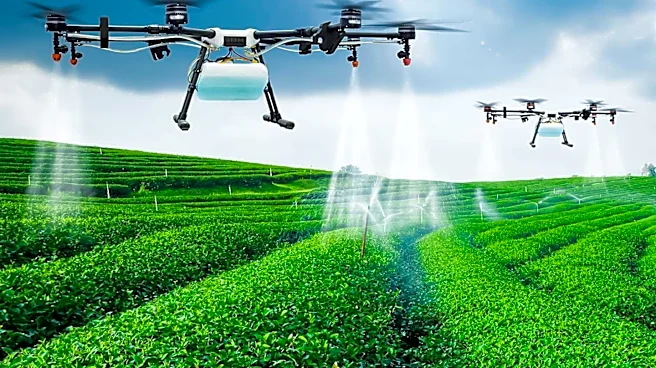
research projects focused on advancing AI in agriculture. These projects include developing specialized AI software to analyze drone images of fields for disease resistance and yield, creating precision weed sprayers that use AI-driven machine vision to target weeds, and utilizing AI-assisted statistical analysis to breed peanuts with improved roasted flavor. Additionally, AI-driven cameras are being developed to non-destructively identify fertile eggs in the poultry industry. The UGA Grand Farm, a 250-acre site, serves as a 'living lab' for field-testing and showcasing these AI innovations.
Why It's Important?
The integration of AI into Georgia's agriculture sector holds significant implications for resource management, profitability, and sustainability. By enabling precise identification of crop issues, targeted application of herbicides and fungicides, and efficient breeding programs, AI can lead to substantial reductions in chemical use and waste. For instance, precision weed sprayers have shown a 60% reduction in herbicide use, and LiDAR-equipped sprayers for pecan trees achieved similar savings in fungicide chemicals. These advancements can lower operational costs for farmers, increase crop yields, and minimize environmental impact. The research also aims to improve food quality, such as enhancing peanut flavor, and streamline industrial processes like egg sorting, contributing to a more efficient and sustainable food system in the U.S.
What's Next?
UGA's IAI will continue to fund and support interdisciplinary AI research projects, with the goal of translating these innovations into practical applications for Georgia farmers. The UGA Grand Farm will play a crucial role in this process, serving as a hub for developing and evaluating new agricultural technologies under real-world conditions. This 'living lab' will host field days, tech demonstrations, and workshops, providing growers, researchers, and students with hands-on experience and opportunities to share knowledge. The ongoing research, including the development of AI models for predicting peanut flavor and the PrecisionDetect instrument for egg screening, suggests a future where AI-driven solutions become increasingly integral to modern agriculture, potentially expanding beyond Georgia to benefit the broader U.S. agricultural industry.
Beyond the Headlines
The application of AI in agriculture, as demonstrated by UGA's initiatives, highlights a broader shift towards data-driven and precision farming. This technological evolution could lead to a more resilient and efficient food supply chain, addressing challenges such as food security and environmental stewardship. The reliance on vast datasets and sophisticated algorithms for training AI systems also underscores the importance of data collection and analysis in modern agriculture. Furthermore, the interdisciplinary nature of these projects, combining expertise from crop and soil sciences, food science, and engineering, exemplifies a collaborative approach to innovation. This integration of AI could redefine the skill sets required in the agricultural workforce, necessitating new training and education programs to prepare for a technologically advanced farming future.