


What's Happening?
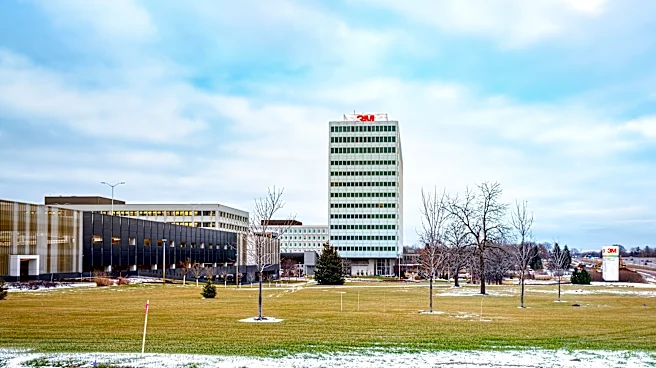
3M Company's board of directors approved a new $6 billion share repurchase authorization on November 3, 2026. This decision follows a period of financial adjustments for the company, including a dividend cut in 2024 after the spin-off of its health care
business, Solventum. Despite this, 3M has shown a financial turnaround, with its adjusted operating margin expanding by 110 basis points to 26.2% and adjusted earnings per share (EPS) reaching $2.50, surpassing the $2.39 consensus. The Safety and Industrial segment reported a 9.1% increase in sales, with operating income rising to $960 million from $792 million. The company also highlighted an expanded data center partnership with Amazon, projected to generate $6 billion in cumulative sales, as a new growth avenue. Chief executive William Brown noted expectations for 'double-digit EPS growth and robust free cash flow.' The dividend payout is currently well-covered, utilizing approximately 34% of the midpoint of 3M's adjusted EPS guidance of $9.10 to $9.15. Year-to-date, 3M has paid $1.2 billion in dividends against $3.1 billion in free cash flow, with an anticipated adjusted free cash flow of about $4.8 billion for the full year.
Why It's Important?
The approval of a $6 billion share repurchase authorization by 3M signals confidence from the company's leadership in its financial health and future prospects, despite a recent dividend reset. This move can positively impact shareholder value by reducing the number of outstanding shares, potentially increasing EPS and stock price. For investors, particularly those focused on dividend income, 3M's ability to cover its dividend with approximately 34% of its adjusted EPS guidance and generate substantial free cash flow (expected to be $4.8 billion for the full year) indicates a stable and growing payout, even after the 2024 cut. The expansion of its adjusted operating margin and strong sales growth in the Safety and Industrial segment demonstrate operational efficiency and market demand for its products. The new partnership with Amazon in the data center market represents a significant strategic move, opening up a substantial growth market and diversifying revenue streams. This financial resilience and strategic growth are crucial for 3M's long-term stability and its position within the industrial sector, influencing investor sentiment and potentially attracting new capital.
What's Next?
3M's financial trajectory will be closely watched, particularly concerning its ability to sustain 'double-digit EPS growth and robust free cash flow' as projected by Chief executive William Brown. The impact of the $6 billion share repurchase authorization on the company's stock performance and shareholder returns will unfold in the coming months. Investors will also monitor the progress and revenue generation from the expanded data center partnership with Amazon, which is expected to contribute $6 billion in cumulative sales. A key area of focus will be the resolution and financial implications of 3M's AFFF personal injury litigation. While a broad resolution was announced on November 3, 2026, the exact costs and payment schedule will significantly influence cash flow in 2027. The company has also scheduled an investor event on November 20, 2026, which may provide further insights into its strategic direction and financial outlook. The market will be looking for continued operational improvements and effective management of litigation costs to ensure sustained financial health and dividend growth.
Beyond the Headlines
The narrative surrounding 3M's financial restructuring, particularly the dividend cut in 2024, highlights a broader trend among established industrial giants adapting to changing market conditions and legal challenges. The decision to cut the dividend, ending its 'Dividend King' status, underscores the strategic imperative to prioritize long-term financial health and investment in growth areas over maintaining historical payout traditions. This move, while initially unsettling for some investors, appears to be paving the way for a more sustainable financial model, as evidenced by the subsequent dividend increases and strong free cash flow generation. The ongoing litigation costs, particularly related to PFAS, represent a significant ethical and financial challenge for 3M, reflecting the increasing scrutiny on environmental liabilities for industrial companies. The company's ability to navigate these legal complexities while simultaneously pursuing growth opportunities, such as the Amazon partnership, will be a critical test of its corporate resilience and adaptability in a rapidly evolving business landscape. This situation could serve as a case study for other legacy companies facing similar pressures to balance shareholder expectations with environmental responsibility and strategic transformation.