



What's Happening?
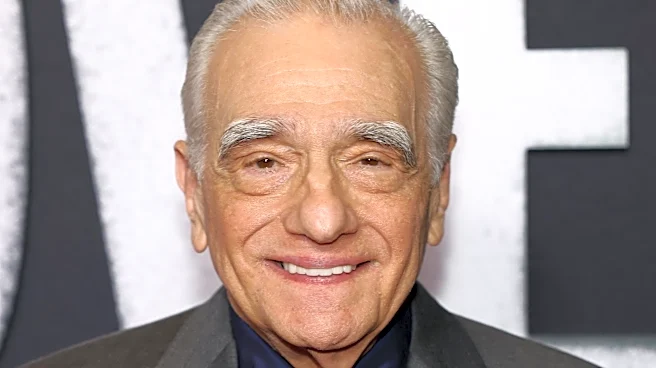
Legendary filmmaker Martin Scorsese has humorously attributed the failure of his planned 'Cleopatra' movie, which was set to star Angelina Jolie, to Seth Rogen's 2014 film 'The Interview.' In an interview with his daughter Francesca for the Tribecca series
Crafty, Scorsese recounted that the controversy surrounding 'The Interview,' which depicted an assassination plot against North Korean leader Kim Jong-un, led to a major Sony hack and threats. Scorsese stated that Kim Jong-un's negative reaction to Rogen's film 'ruined Cleopatra.' Despite this, Scorsese clarified that his comments were made in good humor, noting his working relationship with Rogen. Scorsese himself played a fictionalized version of himself in the Emmy-winning TV show 'The Studio,' where Rogen portrayed a studio executive who cancels a movie by Scorsese.
Why It's Important?
This anecdote highlights the unforeseen and far-reaching consequences that can arise from creative works, particularly in the entertainment industry. 'The Interview' incident, which involved a state-sponsored cyberattack and international diplomatic tensions, demonstrated the vulnerability of U.S. corporations to foreign interference and the potential for cultural products to ignite geopolitical disputes. For Hollywood, it underscored the risks associated with controversial content and the need for studios to navigate complex international relations. Scorsese's humorous take on the situation also reflects the resilience and adaptability within the film industry, where even significant setbacks can eventually be recontextualized. The incident served as a stark reminder of the interconnectedness of global politics, technology, and entertainment, impacting production decisions and security protocols for future projects.
What's Next?
While Scorsese's 'Cleopatra' project is unlikely to be revived in its original form, the story serves as a cautionary tale for future film productions dealing with sensitive geopolitical themes. The entertainment industry continues to grapple with cybersecurity threats and the potential for international backlash, leading to increased scrutiny of scripts and production security. The ongoing relationship between Scorsese and Rogen, as evidenced by their collaboration on 'The Studio,' suggests that creative partnerships can endure even after past controversies. This incident may also contribute to a broader discussion within Hollywood about creative freedom versus geopolitical responsibility, influencing how studios approach projects that could have international implications. The humor with which Scorsese recounts the event indicates a degree of acceptance and perhaps a lesson learned about the unpredictable nature of global events impacting artistic endeavors.
Beyond the Headlines
Beyond the immediate impact on film production, the 'The Interview' controversy and Scorsese's reflection on it touch upon deeper issues of artistic expression, censorship, and international relations. The incident sparked debates about whether creative works should be constrained by potential political repercussions and the extent to which governments can influence cultural output. It also highlighted the power of cyber warfare as a tool for state actors to retaliate against perceived slights. Scorsese's lighthearted perspective, despite the significant financial and creative losses, suggests a philosophical acceptance of the unpredictable nature of the world. This event remains a notable case study in the intersection of entertainment, technology, and global politics, illustrating how a single film can inadvertently become a flashpoint for international conflict and reshape industry practices.