





What's Happening?
U.S. bank stocks experienced a significant recovery on Monday, with both money center and regional banks posting solid gains. This rebound effectively erased the losses incurred during Friday's trading session. The State Street SPDR S&P Bank ETF (KBE)
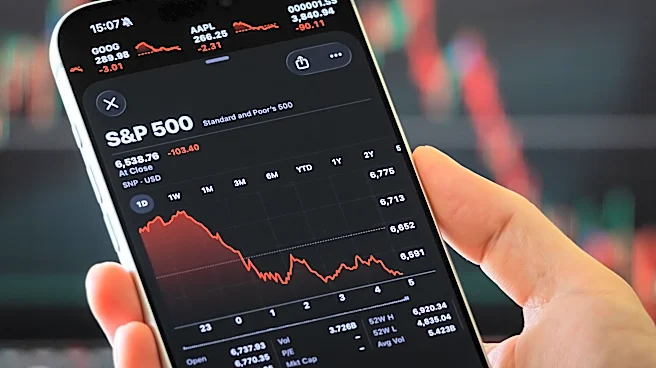
rose by 1.7% to $63.36 in midday trading, reversing its 1.5% drop from Friday. Despite this recovery, the ETF remains 4.7% below its closing price on November 13. Year-to-date, the KBE has increased by approximately 4.3%, which still lags behind the S&P 500's 5.8% advance. Among the money center banks, Morgan Stanley climbed 4.4%, Goldman Sachs jumped 4.2%, Citigroup added 3.7%, Bank of America rose 2.8%, JPMorgan Chase increased 2.5%, and Wells Fargo advanced 2.1%. Regional banks also saw strong performance, with the State Street SPDR S&P Regional Banking ETF (KRE) growing by 1.4%. KeyCorp, a Cleveland, Ohio-based holding company for KeyBank National Association, added 2.3% to its stock price.
Why It's Important?
The recovery of bank stocks is important as it signals a potential stabilization in the financial sector after a period of volatility. The banking industry is a critical component of the U.S. economy, and its performance often reflects broader economic health. A rebound in bank stocks can instill confidence among investors and consumers, potentially encouraging investment and spending. The gains across both large money center banks and regional institutions suggest a widespread positive sentiment, which could mitigate concerns about financial stability. For individual investors, the performance of these stocks directly impacts their portfolios, especially those with exposure to financial sector ETFs or individual bank holdings. The fact that the KBE is still lagging the S&P 500 year-to-date indicates that while there's a recovery, the banking sector might still be navigating underlying challenges or slower growth compared to the broader market.
What's Next?
The immediate next steps for the banking sector will involve monitoring whether this recovery is sustained or if it represents a temporary bounce. Investors will be closely watching for further economic indicators and corporate earnings reports from banks to assess the sector's long-term trajectory. The performance of the State Street SPDR S&P Bank ETF (KBE) and the State Street SPDR S&P Regional Banking ETF (KRE) will serve as key barometers for the overall health of the banking industry. Continued gains could signal a more robust recovery, while renewed declines might indicate persistent headwinds. The broader market's performance, particularly the S&P 500, will also influence bank stock movements, as the financial sector is often sensitive to overall economic sentiment and growth prospects. The focus will be on whether the sector can close the gap with the S&P 500's year-to-date performance.
Beyond the Headlines
Beyond the immediate stock price movements, the banking sector's performance has broader implications for credit availability and economic growth. A strong banking sector is essential for facilitating lending to businesses and consumers, which in turn supports investment, job creation, and economic expansion. Conversely, a struggling banking sector can lead to tighter credit conditions, potentially hindering economic activity. The distinction between the performance of money center banks and regional banks is also noteworthy; regional banks often have a more direct impact on local economies. Their recovery suggests a potential strengthening of local financial ecosystems. The ongoing comparison of the KBE's performance against the S&P 500 highlights the nuanced recovery, indicating that while the sector is improving, it may still be facing specific challenges or a different growth profile compared to other industries.