




What's Happening?
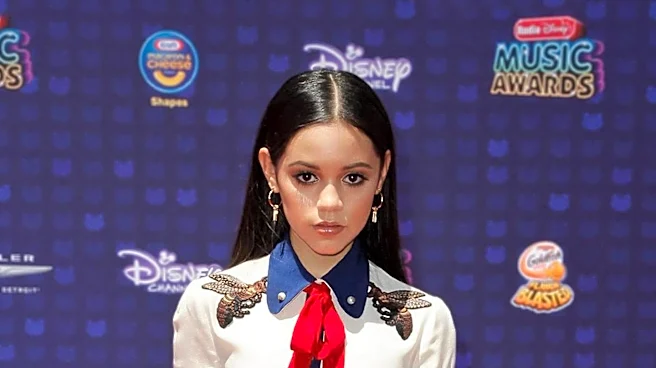
Actress Jenna Ortega, known for her role as Wednesday Addams in the Netflix series 'Wednesday,' has stated she will no longer compliment fans on their costumes or appearance in public. This decision stems from two separate incidents where her attempts
to praise fans were met with negative reactions, making her feel like a 'creep.' One instance occurred during Halloween in Brooklyn, New York, when she complimented a girl dressed as Enid, Wednesday's roommate, only to have the girl look at her as if she were a 'creep.' A second incident involved a six-year-old girl whose wig was falling off; Ortega's compliment led the child to run back to her classmates, seemingly scared. Ortega, who has been on a press tour in the UK for her latest film, 'Klara and the Sun,' shared these experiences during an interview on Greatest Hits Radio with host Zoe Ball. She explained that she now prefers to 'leave them be' to avoid similar misunderstandings.
Why It's Important?
This situation highlights the unique challenges faced by public figures in their interactions with fans, particularly in casual settings. While seemingly innocuous, a celebrity's attempt at a friendly gesture can be misinterpreted, leading to discomfort for both parties. For Ortega, these experiences have altered her approach to fan engagement, demonstrating how personal boundaries and public perception can be complex for those in the entertainment industry. It also underscores the potential for miscommunication when a power dynamic exists, even in seemingly innocent interactions. The incidents reflect a broader societal shift where public figures are increasingly cautious about unsolicited interactions, especially with minors, to prevent any misinterpretation or accusations of inappropriate behavior. This could lead to a more reserved approach from celebrities in public, potentially impacting the spontaneous fan interactions that many value.
What's Next?
Jenna Ortega's decision suggests a continued cautious approach to public interactions with fans, particularly regarding compliments on appearance or costumes. Other public figures may adopt similar strategies to navigate fan encounters, prioritizing personal comfort and avoiding potential misunderstandings. This could lead to a more formalized or structured approach to fan engagement, such as designated meet-and-greets or Q&A sessions, rather than spontaneous interactions in public spaces. The entertainment industry might see a subtle shift in how celebrities are advised to interact with the public, emphasizing clear boundaries and minimizing situations that could be misconstrued. Fans, in turn, might need to adjust their expectations for casual encounters with their favorite stars, understanding that celebrities may be more reserved due to past negative experiences.
Beyond the Headlines
Beyond the immediate impact on Ortega's fan interactions, this situation touches upon broader themes of celebrity culture, public perception, and the evolving nature of personal space in an increasingly scrutinized world. The incidents reveal the double-edged sword of fame, where genuine attempts at kindness can be misconstrued due to the inherent power imbalance and public's often-unrealistic expectations of celebrities. It also raises questions about the impact of social media and heightened awareness of personal safety, which can contribute to a climate of suspicion even in innocent encounters. The narrative of a celebrity being perceived as a 'creep' for a simple compliment underscores the fragility of public image and the constant pressure on public figures to maintain an impeccable reputation, even in everyday situations. This could contribute to a more guarded and less spontaneous celebrity culture, where interactions are carefully curated to avoid any potential missteps.