




What's Happening?
Bentic, formerly known as sewts, is preparing to expand its commercial presence into the United States, with its physical AI robot installations nearing 100 at customer production sites globally. The Munich-based company specializes in technology that
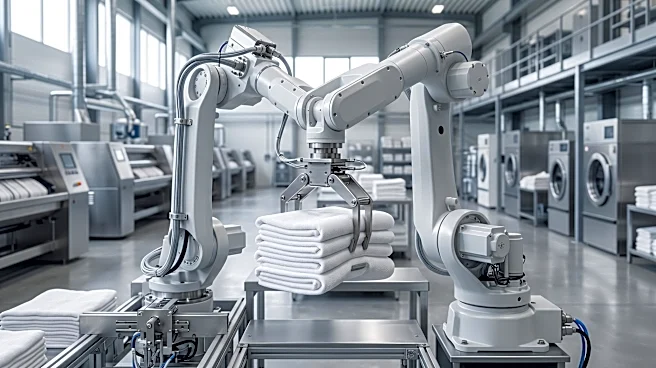
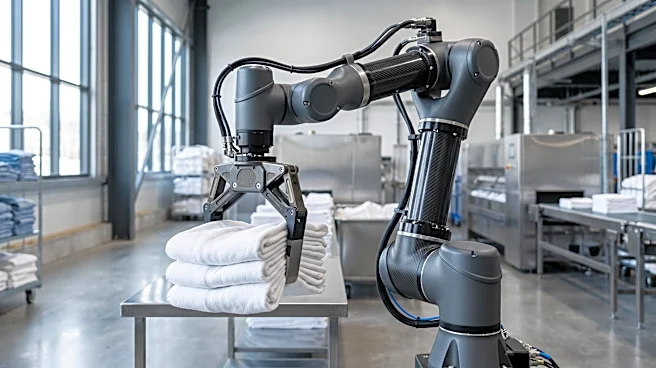
enables industrial robots to reliably handle deformable materials such as textiles, cables, carbon fiber, and food—tasks traditionally requiring human dexterity. Bentic's approach involves training AI with real-world industrial data, allowing its systems to learn from actual production environments rather than relying solely on laboratory testing and simulation. This operational experience enhances the robots' ability to recognize and manipulate materials under changing conditions. The company's technology combines a foundational intelligence that predicts deformable material behavior with an action model that translates these predictions into robot movements. Bentic's robot-agnostic platform, Jupiter, allows individual robots to benefit from the collective operational experience of the entire installed fleet, improving performance across various materials and applications. Emerald Technology Ventures, which led Bentic's €7 million Series A financing in August 2023, is backing this U.S. expansion, with the first systems expected to be delivered before the end of 2026.
Why It's Important?
Bentic's expansion into the U.S. market signifies a significant advancement in industrial automation, addressing a long-standing limitation in robotics: the inability to consistently handle materials that change shape or move unpredictably. This technology has the potential to revolutionize manufacturing processes across various U.S. industries, including textile processing, e-commerce returns, automotive cable harnesses, and food processing, where manual labor is often still required for delicate or irregular materials. By automating these complex tasks, U.S. manufacturers can achieve greater efficiency, reduce labor costs, improve consistency, and enhance worker safety. The ability of Bentic's robots to learn from real-world data also means that their performance will continuously improve, offering a scalable and adaptable solution for diverse production environments. This development could bolster the competitiveness of U.S. manufacturing by enabling higher levels of automation in sectors previously resistant to it.
What's Next?
Bentic expects to deliver its first physical AI robot systems to U.S. customers before the end of 2026, marking the official commencement of its commercial operations in the country. The company will focus on manufacturers seeking to automate processes involving flexible, irregular, and difficult-to-handle materials. As installations grow, Bentic's Jupiter platform will continue to accumulate real-world training data, further enhancing the capabilities and adaptability of its robot fleet. This expansion will likely lead to increased adoption of physical AI in U.S. industrial settings, potentially spurring other robotics companies to develop similar solutions for deformable materials. The success of Bentic's deployment in the U.S. could also attract further investment in the industrial AI and robotics sector, fostering innovation and creating new opportunities for automation across various industries.
Beyond the Headlines
The rise of physical AI, as demonstrated by Bentic, represents a paradigm shift in industrial robotics, moving beyond rigid, predictable environments to embrace the complexities of the real world. This has profound implications for the future of work, as robots become capable of performing tasks previously considered exclusively human. While this could lead to increased productivity and economic growth, it also raises questions about workforce displacement and the need for retraining programs to equip workers with new skills for an automated economy. Ethically, the deployment of AI-powered robots in handling sensitive materials like food requires stringent safety protocols and quality assurance measures. Culturally, the increasing presence of highly adaptable robots in factories could reshape perceptions of automation, moving from a threat to a collaborative tool that augments human capabilities. This technology also highlights the growing importance of data-driven learning in robotics, where real-world operational experience becomes a critical asset for continuous improvement.