



What's Happening?
Neptune Robotics has secured two significant partnerships to advance the adoption of its AI-powered robotic hull cleaning technology. The latest agreement is with the Dutch-French multinational Louis Dreyfus Company (LDC), under which Neptune will deploy
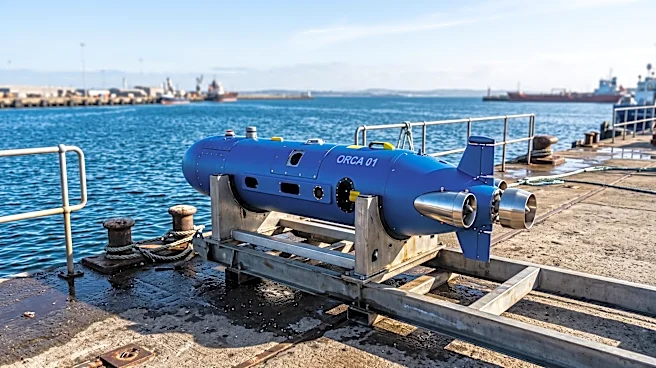
its robotic services on a fleet of 300 vessels chartered by LDC. This partnership, administered under the Maritime and Port Authority of Singapore’s (MPA) In-Water Hull Inspection & Cleaning Innovation Program, aims to enhance vessel efficiency and reduce emissions. LDC will provide vessels for testing Neptune’s technology under real operating conditions, with findings expected in 2028. Earlier this month, Neptune also entered into a similar agreement with Cargill, one of the world's largest dry bulk operators. Neptune’s robotic system is designed to clean flat bottoms and vertical sides of hulls, preserve antifouling coatings, and capture removed material. These robots can clean capesize vessels within 24 hours, counter four-knot currents, and operate day and night in various water conditions, using cavitational waterjets to remove marine growth.
Why It's Important?
These partnerships are critical for the maritime industry, which faces increasing pressure to improve efficiency and reduce its environmental footprint. Biofouling, the accumulation of marine organisms on ship hulls, can increase a vessel's fuel consumption by up to 30 percent. By deploying AI-powered robotic hull cleaning, Neptune Robotics offers a solution that can significantly cut fuel costs and lower greenhouse gas emissions. The collaboration with major players like Louis Dreyfus Company and Cargill provides a large-scale testing ground for this technology, validating its effectiveness and reliability in real-world scenarios. This could accelerate the widespread adoption of robotic hull cleaning, leading to substantial economic benefits for shipping companies through reduced operational expenses and improved vessel performance. Furthermore, the environmental advantages align with global sustainability goals, positioning this technology as a key innovation in green shipping practices.
What's Next?
The partnership with Louis Dreyfus Company will run for 18 months, during which both companies will evaluate operating procedures, cleaning efficiency, and the data generated by the AI-powered robots. Detailed hull condition assessments and measurements of fuel consumption reductions will be conducted through before-and-after performance analysis. The findings from this extensive testing are expected to be released in 2028. Success in these large-scale deployments with LDC and Cargill could pave the way for broader commercialization and adoption of Neptune Robotics' technology across the global maritime industry. The insights gained will be crucial for refining the robotic systems and demonstrating their long-term economic and environmental benefits, potentially leading to new industry standards for hull maintenance and biofouling management.
Beyond the Headlines
The adoption of robotic hull cleaning technology represents a broader trend towards automation and AI integration in traditionally manual and labor-intensive industries. Beyond the immediate benefits of fuel efficiency and emission reduction, this shift could impact maritime labor, potentially leading to a demand for new skill sets in robotics operation and maintenance. The data collected by these AI-powered robots on hull conditions and performance could also contribute to predictive maintenance strategies, further optimizing vessel operations and extending the lifespan of antifouling coatings. This technological advancement highlights the increasing role of smart solutions in addressing complex industrial challenges, pushing the maritime sector towards a more sustainable and technologically advanced future. The success of such initiatives could also inspire similar robotic applications in other challenging industrial environments.