
What's Happening?
The United Nations Conference on Trade and Development (UNCTAD), in partnership with the State of Qatar, is introducing 'Investing in Space: The Final Frontier' as a new focus area for the 2026 World Investment
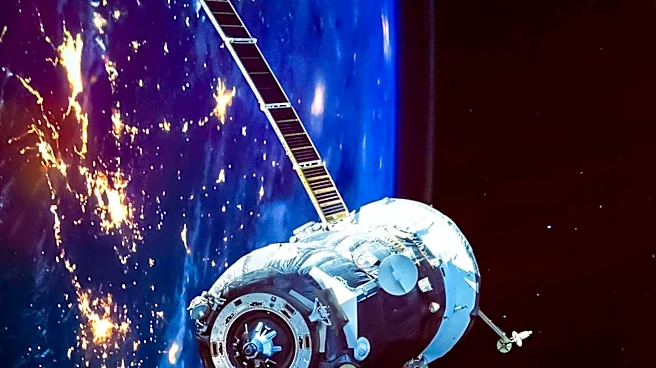
Forum (WIF) in Doha. This initiative aims to help Qatar and other Middle Eastern nations become key players in the burgeoning space economy, a sector traditionally dominated by a few global powers. Nan Li Collins, chair of the UN Sustainable Stock Exchange Division, announced that this new track will be organized in collaboration with the UN Office for Outer Space Affairs (UNOOSA), which specializes in outer space governance and investment partnerships. The goal is to explore how countries can develop their space economies, identify trends, opportunities, and challenges, and facilitate knowledge sharing among advanced companies. This move comes as global foreign direct investment (FDI) is increasingly concentrated in strategic high-tech areas, with UNCTAD seeking to prevent a similar hyper-concentration in space technology.
Why It's Important?
This initiative is significant because it addresses the growing disparity in global investment flows, particularly in advanced technological sectors like the space economy. By actively working to broaden participation, UNCTAD aims to prevent the space sector from becoming an exclusive domain of a few nations, ensuring that developing countries are not left behind. The focus on the Middle East, and Qatar specifically, highlights the region's potential to diversify its economy beyond traditional energy sectors and leverage its growing technological infrastructure. Dr. Vincent Beyer, legal officer at UNCTAD, noted that the Gulf Cooperation Council (GCC) has seen a sixfold increase in its global share of attracted FDI over the past decade, with significant growth in information and communication technology (ICT) investments. This foundation provides the region with the technical and digital capabilities needed to support satellite infrastructure and spatial data services, making UNCTAD's efforts crucial for fostering inclusive global economic development in a critical emerging industry.
What's Next?
The World Investment Forum (WIF) 2026, scheduled for October 25-27 at the Sheraton Grand Doha Resort & Convention Hotel, will serve as the primary platform for advancing this agenda. During the forum, policymakers, investors, and advanced companies will engage in discussions to identify entry barriers for developing nations in the space supply chain and explore collaborative strategies to move the agenda forward. UNCTAD officials, including Nan Li Collins and Dr. Vincent Beyer, will continue to work with UNOOSA to provide guidance and technical assistance. The forum is expected to showcase experiences from companies already investing in the space economy and facilitate partnerships. The ongoing monitoring of global FDI trends, particularly in strategic high-tech areas, will inform future UNCTAD initiatives to ensure that space technology development is more equitable and inclusive, preventing capital from pooling among a select few nations.
Beyond the Headlines
The push for wider participation in the space economy by UNCTAD carries deeper implications for global equity and sustainable development. The concentration of FDI in advanced technologies, as highlighted by UNCTAD's World Investment Report 2026, risks exacerbating existing economic inequalities between developed and developing nations. By actively promoting the inclusion of countries like Qatar and others in the Middle East, UNCTAD is not just fostering economic growth but also addressing the ethical imperative of ensuring that the benefits of technological advancements are shared more broadly. This initiative could lead to a more diversified global space industry, fostering innovation from a wider range of perspectives and potentially leading to more resilient and inclusive technological ecosystems. It also underscores the evolving nature of global trade and investment, where new frontiers like space are becoming critical battlegrounds for economic influence and technological leadership.