


What's Happening?
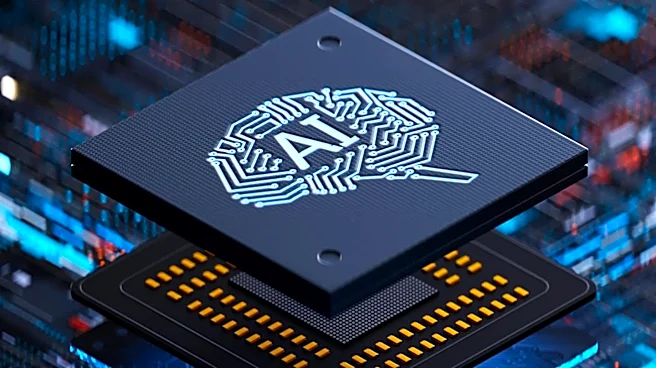
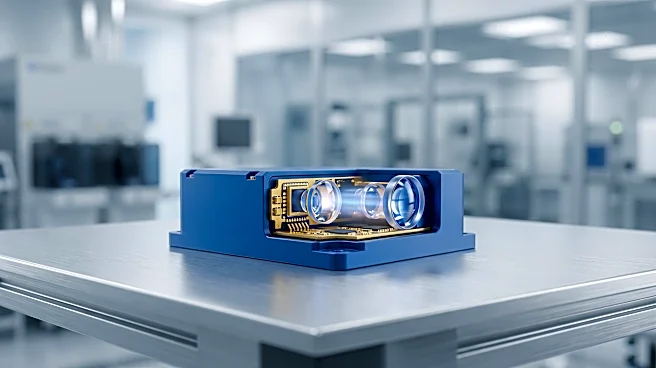
Lightmatter, an MIT spinout, is at the forefront of developing photonic AI chips that compute with light rather than electrons. In April 2025, the company published a Nature paper detailing a six-chip package featuring four 128-by-128 photonic tensor
cores. This system successfully ran ResNet, BERT, and an Atari-playing reinforcement-learning agent with near 32-bit accuracy, achieving 65.5 trillion 16-bit operations per second on 78 watts of electrical and 1.6 watts of optical power. While photonic AI chips are often touted for their potential to be significantly faster and more energy-efficient than traditional GPUs, the term 'photonic AI chip' encompasses two distinct products: those that compute with light and those that use light to move data. Lightmatter's public roadmap increasingly emphasizes its Passage optical interconnect technology, with near-packaged optics deployments planned for this year and co-packaged optics in 2027. This indicates a dual focus on both light-based computation and optical data transfer solutions for AI infrastructure.
Why It's Important?
The development of photonic AI chips by companies like Lightmatter is crucial for addressing the escalating energy demands and computational bottlenecks in the artificial intelligence sector. Traditional GPUs, while powerful, consume substantial electricity, leading to delays and cancellations in data center projects due to power constraints. Photonic processors offer a potential solution by performing the core operation of neural networks—multiplying a vector by a matrix—with significantly less energy. Lightmatter's 2025 system, for instance, was estimated to be roughly three times faster and ten times more energy-efficient than an Nvidia A100. If these technologies scale effectively, they could provide a second, more energy-efficient hardware answer to AI inference challenges, diversifying the compute landscape beyond GPU reliance. This shift could alleviate pressure on GPU supply chains and grid capacity, which are currently major industry constraints, ultimately making AI inference more accessible and sustainable.
What's Next?
Lightmatter's immediate future involves the deployment of its Passage optical interconnect technology, with near-packaged optics expected this year and co-packaged optics by 2027. This indicates a strategic move to integrate optical data transfer solutions into existing AI infrastructure, potentially enhancing the performance of current GPU-based systems. For its photonic computing chips, the company, along with others in the field, faces the challenge of scaling precision, managing conversion overhead, and optimizing packaging for mass production. While volume products from competitors are slated for 2028 and 2029, Lightmatter's continued research and development in photonic tensor cores suggest a long-term vision for light-based computation. The industry will be watching to see how these photonic solutions integrate with and potentially transform the data centers of 2028 and beyond, particularly in addressing the compute-bound aspects of AI inference.
Beyond the Headlines
The broader implications of Lightmatter's work extend to a fundamental shift in how AI computations are performed, moving beyond the limitations of silicon-based electronics. While photonic chips are not general-purpose GPU replacements and cannot run arbitrary code or train frontier models, their specialized capability in energy-efficient matrix multiplication for inference could redefine the economics of AI deployment. The analog nature of light-based computation introduces challenges like noise and precision, which Lightmatter has addressed through careful calibration and custom number formats. This highlights the innovative engineering required to bridge the gap between physics and practical computing. Furthermore, the dual focus on optical interconnects suggests that photonics will first enhance existing GPU architectures by improving data transfer speeds before potentially replacing them for specific computational tasks. This evolutionary path underscores a pragmatic approach to integrating new physics into the established AI hardware ecosystem, promising a future where AI is both more powerful and more sustainable.