







What's Happening?
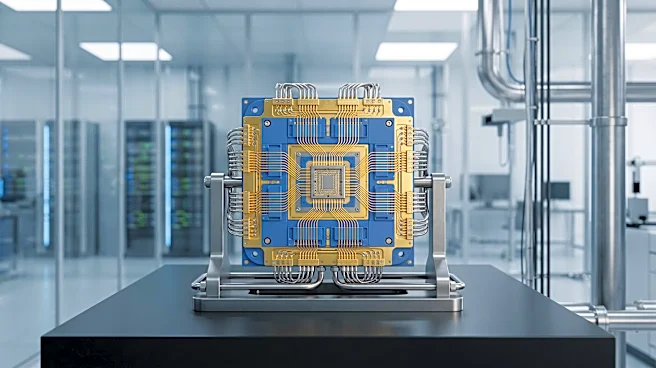
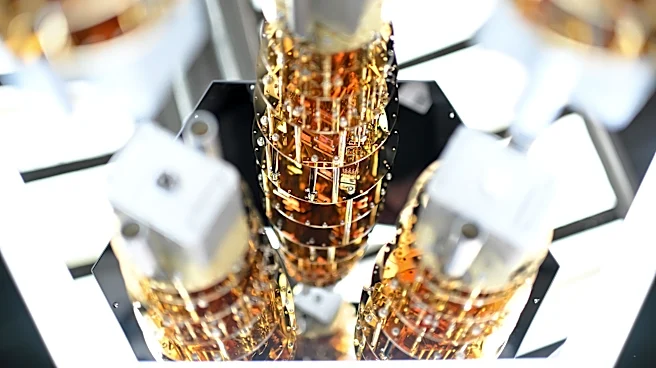
Diraq has deployed the world's first silicon spin quantum computer in a commercial data center, located at Equinix in Sydney, Australia. This marks a significant milestone in bringing quantum computing into mainstream infrastructure. The system currently
operates with eight qubits, and Diraq aims to scale it to 256 qubits within the next year, utilizing the same semiconductor manufacturing processes as conventional computer chips. This approach allows for increased computing power by upgrading the quantum processor with minimal changes to existing data center infrastructure. Diraq's quantum computer is designed to be compact and relatively low-power, drawing less than 20 kW currently and an estimated 300 kW for a future utility-scale system, which is less than a third of the power demanded by a single next-generation AI rack. The current system occupies 172 square feet, with future utility-scale deployments potentially as small as 54 square feet.
Why It's Important?
This deployment is crucial for the U.S. and global technology landscape as it demonstrates a viable path for integrating quantum computing into existing commercial data centers. Diraq's silicon spin approach, which leverages established semiconductor manufacturing, offers a scalable and cost-effective solution, potentially accelerating the adoption of quantum technology. The U.S. Department of Commerce has recognized Diraq's potential, with a US$38 million letter of intent under the CHIPS and Science Act, highlighting the strategic importance of this technology. The economic value of quantum computing is projected to be substantial, with estimates suggesting it could contribute up to $3.5 trillion at maturity. This advancement could revolutionize industries such as medicine, energy, materials, climate, and transport, by enabling solutions to complex problems that are currently beyond the reach of conventional computers. For instance, quantum computing could significantly improve clinical trial success rates, leading to more life-saving medicines reaching patients faster and at lower costs.
What's Next?
Diraq's immediate next step is to scale its system to 256 qubits within the next year, which will serve as a critical proof point for its technology. The company is also launching a report, 'Quantum at Work,' to explore the potential contributions of quantum computing across various fields. This deployment is part of Diraq's broader strategy to demonstrate that quantum computing can operate alongside existing digital infrastructure. The company's participation in DARPA's Quantum Benchmarking Initiative and its funding under the CHIPS and Science Act indicate continued government and industry support. Future developments will likely focus on further increasing qubit count, enhancing error correction capabilities, and developing practical applications that leverage the unique power of quantum computation, particularly in areas like drug discovery and materials science.
Beyond the Headlines
The deployment of a quantum computer in a commercial data center signifies a shift from theoretical research to practical implementation, blurring the lines between cutting-edge science and everyday technology. The use of silicon spin architecture, compatible with existing semiconductor manufacturing, suggests a more accessible and potentially faster path to widespread quantum adoption compared to other quantum modalities that require more specialized and costly infrastructure. This development also highlights the growing convergence of quantum computing with other advanced technologies like AI and cloud computing, suggesting a future where these technologies work in concert to solve complex problems. The potential for quantum computing to accelerate drug discovery and improve healthcare outcomes underscores its profound societal impact, offering hope for addressing some of humanity's most pressing challenges. The strategic investments by governments, such as through the CHIPS and Science Act, reflect a recognition of quantum computing as a critical technology for national competitiveness and security.